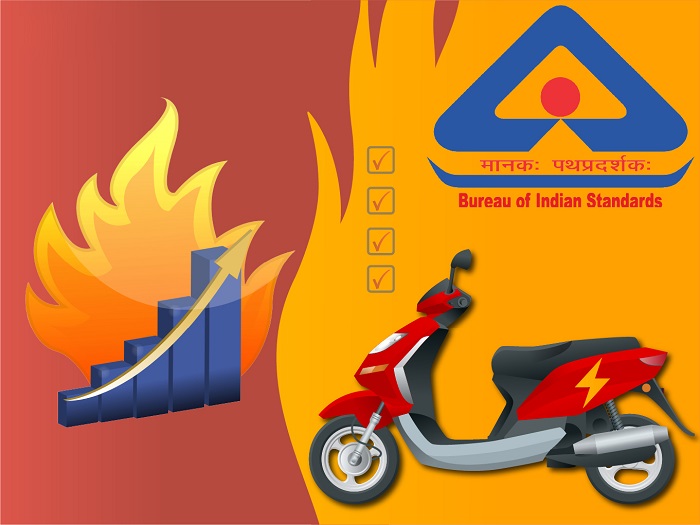

As fires and explosions in electric two-wheelers continue unabated, the government is all set to introduce EV battery standards (BIS standards) for EV two-wheelers that will be expanded to four-wheelers at a later stage.
The BIS standards for EV batteries will look into “size, connectors, specification and minimum quality of cells, the battery’s capacity”.
Acknowledging an urgent need, the sources in the ministry said that it is in touch with the battery industry stakeholders to bring out BIS guidelines for EV batteries, as initial reports have found serious defects in the batteries, including designs of the battery packs and modules.
Earlier, NITI Aayog in a discussion paper also stressed the need for BIS standards as the first step toward a national battery swapping policy.
The preliminary findings from the government-constituted probe committee on EV fires have already identified issues with battery cells or design in nearly all of the electric two-wheeler fire incidents in the country.
The committee was constituted in the wake of EV fires and battery blasts in e-scooters.
The experts found defects in battery cells as well as battery design in nearly all EV fires.
The government is now working on new quality-centric guidelines for EVs that will be unveiled soon.
The Defence Research & Development Organisation (DRDO) which was tasked with investigating EV fire incidents by the Union Road Transport and Highways Ministry, found serious defects in the batteries.
These defects occurred because the electric two-wheeler manufacturers like Okinawa Autotech, Pure EV, Jitendra Electric Vehicles, Ola Electric, and Boom Motors may have used “lower-grade materials to cut costs”.
The Centre for Fire, Explosive and Environment Safety (CFEES) at the DRDO has submitted its fact-finding report to the Ministry which summoned representatives of these EV manufacturers, asking them to submit an explanation of the DRDO report findings.
Earlier this month, the Central Consumer Protection Authority (CCPA), which comes under the Union Consumer Affairs Ministry, sent notices to Pure EV and Boom Motors after their e-scooters exploded in April.