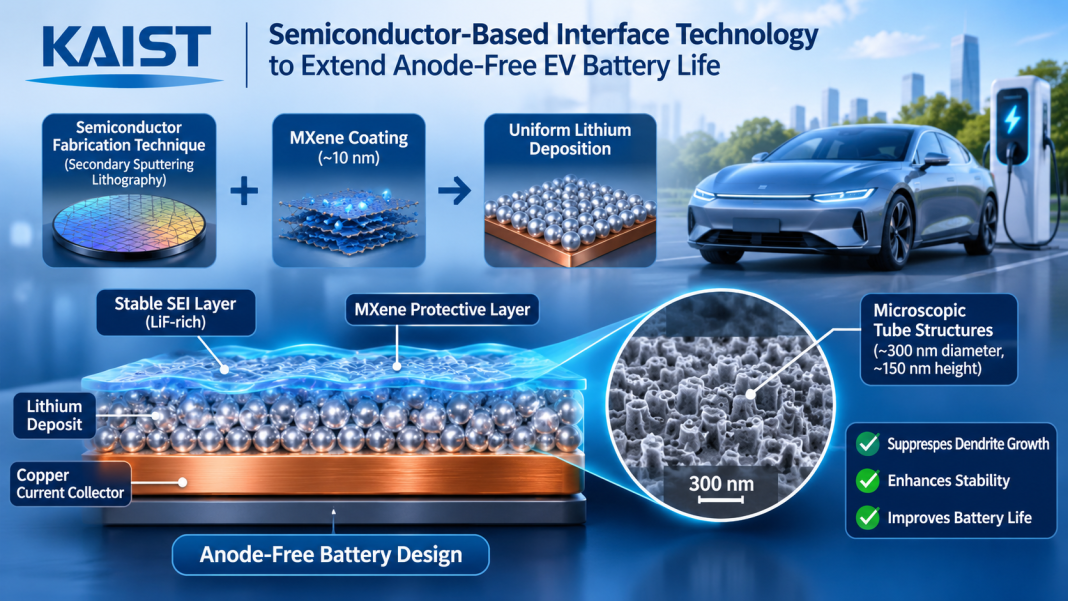

Researchers from the Korea Advanced Institute of Science and Technology (KAIST) have developed a monolithic 2D semimetal-semiconductor interface technology designed to eliminate physical junctions between metal electrodes and semiconductors by forming both regions inside a single atomic-scale film. This could improve the durability of anode free lithium-metal batteries for electric vehicles (EVs). This approach controls lithium deposition and reduces the formation of structures that degrade battery performance.
Conventional lithium-ion batteries use graphite to store lithium at the anode. This approach provides limited energy density and leads to capacity fade over time. The newly developed anode-free batteries address these challenges faced by lithium-ion batteries by depositing lithium directly onto a thin copper current collector during charging, which reduces battery weight and volume while potentially increasing energy density. However, this modern approach also risks damaging internal battery components and shortening battery life due to dendrite formation caused by uneven lithium deposition.
“This study shows how ultrafine fabrication techniques used in semiconductor manufacturing can create both uniform sites for lithium deposition and a stable protective layer without changing the bulk electrolyte formulation or adding excess lithium,” said Professor Jinwoo Lee from KAIST. He further said that this technology is expected to serve as a foundation for accelerating the commercialisation of high-energy anode-free batteries by extending battery life while minimising an increase in weight and volume.
The researchers also applied an approximately 10-nanometer-thick coating of MXene, a two- dimensional material, to the modified copper surface. This coating promotes the formation of a stable, lithium-fluoride-rich protective layer during battery operation. The layer helps reduce unwanted reactions between lithium and the electrolyte while suppressing dendrite growth.
The development highlights how semiconductor fabrication techniques could contribute to next-generation battery manufacturing. Further research and testing will be needed to establish its performance, scalability and suitability for commercial EV battery production.