
Voice interfaces in cars have existed for years, but most have behaved like rigid command menus. The driver had to remember the expected phrase, speak in a predictable way and often repeat the request. The system recognised words; it rarely understood the broader intent behind them. Mahindra and Mahindra’s Gemini-powered MAIA platform shows how conversational AI and over-the-air software are turning the cockpit into an evolving digital system.
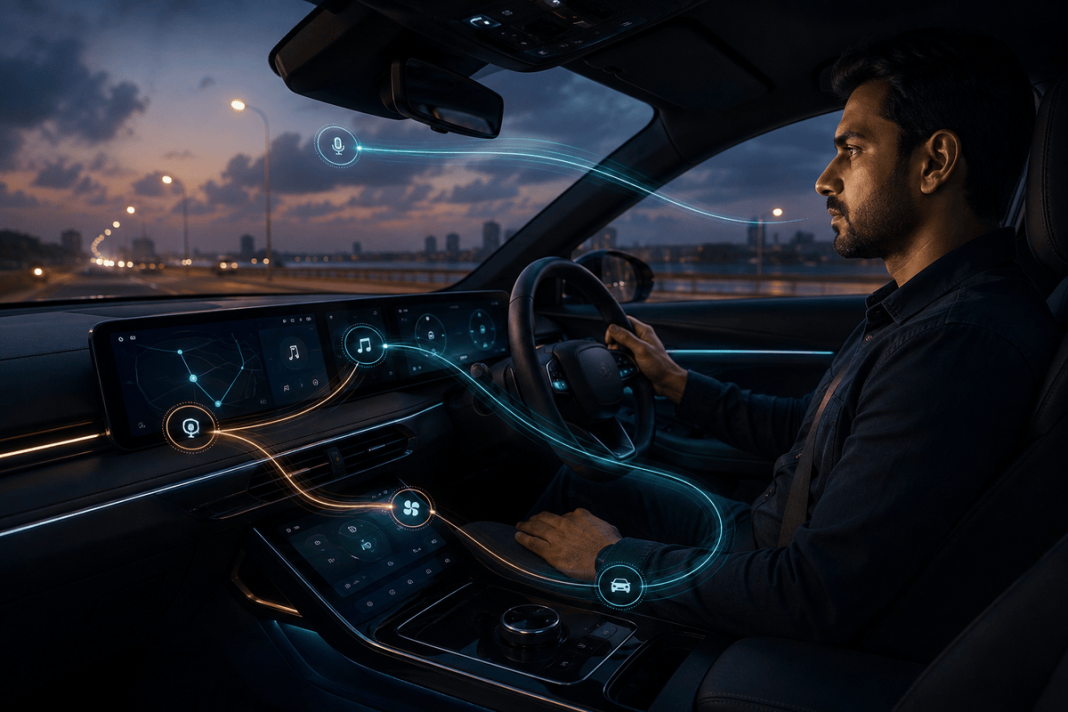
Mahindra’s new BE 6 SPORTEQ points toward a different interaction model. Its MAIA platform integrates an automotive agent built using Gemini Enterprise, and Mahindra describes itself as the first Indian OEM to integrate this form of agent into a vehicle. The TEQ_Talk experience uses 17 specialised AI agents and is designed to support more than 100 core functions across 48 applications, including vehicle controls, navigation, media, weather and access to the owner’s manual.
The headline is conversational AI, but the deeper story is architectural. A vehicle can respond intelligently only if the language layer is connected to trusted vehicle services, application permissions, live context and a safe execution framework. The cockpit is becoming an orchestrator for the software-defined vehicle.
A useful automotive agent must do more than answer a question. It must translate intent into the right vehicle service, at the right time, with the right safety boundary.
From Fixed Commands to Intent
An intent-driven interface can allow a driver to express a goal instead of navigating a hierarchy. “I am feeling cold” could lead the system to adjust the cabin environment; “find a fast charger near a place where I can eat” could combine navigation, charging information and contextual search. The value is not that the sentence sounds natural. It is that several digital services can be coordinated behind a single request.
This can reduce distraction if the interaction is designed well. Drivers should not need to hunt through layers of a touchscreen for a frequently used function. However, conversational design also introduces ambiguity. A system needs to know when to execute, when to confirm, when to refuse and when to fall back to a physical or visual control. The safest experience will be multimodal rather than voice-only.
The Engineering Challenge Sits Behind the Interface
To make an automotive agent dependable, the OEM must define a clean layer of vehicle application programming interfaces. Each service needs permissions, state awareness and predictable behaviour. Safety-critical controls require stricter boundaries than infotainment tasks. The agent must distinguish a harmless request to change a playlist from an action that could alter the vehicle’s physical state.
The edge-cloud balance is equally important. Cloud intelligence can deliver richer models and up-to-date services, but the vehicle must remain useful when connectivity is weak. Latency, cost and privacy may require some processing on board. Engineers therefore need to decide which data leaves the vehicle, which tasks run locally, how consent is managed and how sensitive information is protected.
Cybersecurity also becomes central. An agent connected to multiple vehicle functions expands the importance of identity, authentication, secure APIs, logging and controlled updates. The language model should never become an unrestricted route into vehicle systems. It needs a policy and execution layer that validates every action.
OTA Turns the Cockpit Into a Lifecycle Product
Mahindra says it will introduce new software features in phases from January 2027 for existing BE 6, XEV 9e and XEV 9S vehicles, depending on model and variant. That over-the-air roadmap is as significant as the initial launch. It reflects a shift from delivering a fixed feature list at sale to managing a software product throughout the vehicle’s life.
For the supplier ecosystem, this creates demand for cloud platforms, automotive middleware, validation automation, cybersecurity, localisation, language technologies, human-machine-interface design and fleet analytics. It also changes commercial relationships. This means engineering must continue after start of production, and software quality must be managed across a growing population of vehicles.
Intelligence Without Overstatement
A conversational agent does not make the vehicle autonomous, nor does it remove the driver’s responsibility. Its immediate value is more grounded: simpler interaction, better access to vehicle knowledge, personalised services and an architecture that can evolve through software.
The larger lesson is that the cockpit is no longer a collection of separate screens and switches. It is becoming a software environment that interprets context and coordinates functions. The winners will not be those with the most animated assistant. They will be the companies that combine natural interaction with reliable vehicle integration, strong privacy and disciplined safety design.