
When we think about an Electric Vehicle, we usually question how the working mechanism of an electric vehicle operates. This mechanism includes changing speed during acceleration, turning via the steering wheel, and distributing energy from the battery to different parts of the vehicle. To answer these questions, we need to understand the architecture of an electric vehicle, which consists of different parts such as the battery for energy storage, an on-board charger for power conversion, and a drivetrain to transfer produced torque to the wheels for mechanical motion.
In this article, we’ll understand some basic functionality of an electric vehicle. We will examine the working mechanism of different parts and how a single part coordinates with other components to achieve the practical results we observe while driving a car.
Traction Battery: The Energy Source of an EV
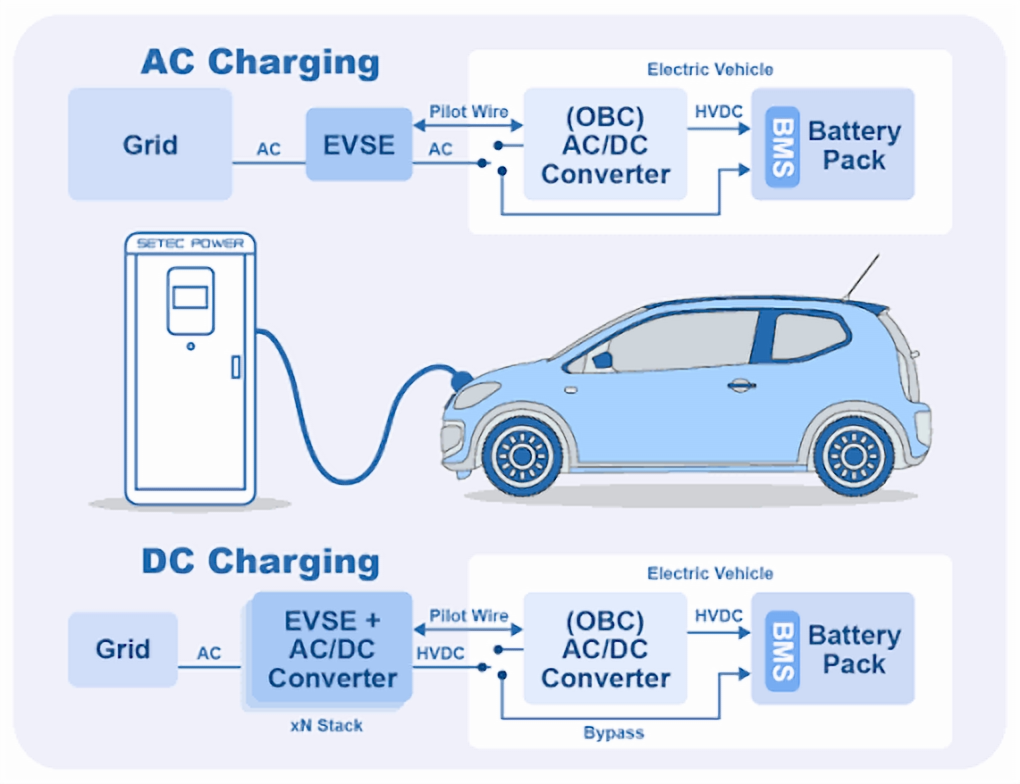
The charging power coming from the power station is in AC form. On-Board Charger converts this alternating current to DC which is then stored in the high-voltage battery pack and DC bus. The stored energy in the form of DC current is passed to the traction battery, which is the main power source for driving an electric vehicle. The power supply to different parts of the electric vehicle comes from this source, which also includes supplying power to the powertrain that produces motion for gaining speed or acceleration.
The other core functionalities of the traction battery include the battery management system (BMS) for preventing overcharge and monitoring cell voltages, current, and temperatures; a thermal management system to balance optimum temperature by using active liquid or air cooling; and storing kinetic energy as electrical energy when applying brakes or slowing down the electric vehicle.
Battery Management System (BMS): Monitoring and Protecting the Battery
The Battery Management System (BMS) acts as the management layer, monitoring different parameters of the energy storage in an electric vehicle such as peak current, voltage, and temperature of a battery cell, to operate the battery within safe limits. It is a combined hardware and software system within the EV battery pack.
BMS estimate state of charge (SoC) in a battery by calculating remaining energy and predict driving range. It also measures the state of health (SoH) of the energy storing devices by analysing capacity degradation and aging, and notifies about the car’s maintenance. It works continuously through a loop of sensing (collecting data), calculations and decision-making on operating conditions, and communicates with the on-board charger and the car’s Electronic Control Unit (ECU) via the CAN (Controller Area Network) bus to adjust power, protect the battery and maximize performance.
Inverter: Converting Battery Power for the Motor
Inverter is a hardware device placed under the front or rear hood, mounted directly on top of the electric motor, or integrated into an e-axle unit. This device communicates between the battery and the traction motor. Energy stored in a battery is direct current (DC); the inverter converts this DC into AC to drive the traction motor. The inverter’s task is also to control the electrical frequency, voltage, and current supplied to the motor to match the motor’s magnetic field and physical load demands.
Inverters in modern electric vehicles are more efficient and smarter compared to their traditional designs. Modern inverters use silicon carbide as a wide-bandgap semiconductor instead of Si IGBTs to reduce switching losses, achieve higher efficiency, superior thermal performance, and decrease physical space.
Vehicle Controls: Coordinating the Entire EV
Different components in an electric vehicle such as the traction motor, on-board charger, battery management system (BMS), and inverter coordinate with each other and various other hardware and software platforms for the proper functioning of an EV. They communicate with each other through the Vehicle Control Unit (VCU) and the communication network (CAN bus) that links every subsystem in real time.
Engineers and EV manufacturers are focusing on shifting from distributed network in the EV architecture towards centralized vehicle controller. A recent example of this can be seen in newly launched Mercedes-Benz Operating System (MB.OS), which controls vehicle through chip-to-cloud and software architecture instead of communication between isolated parts.