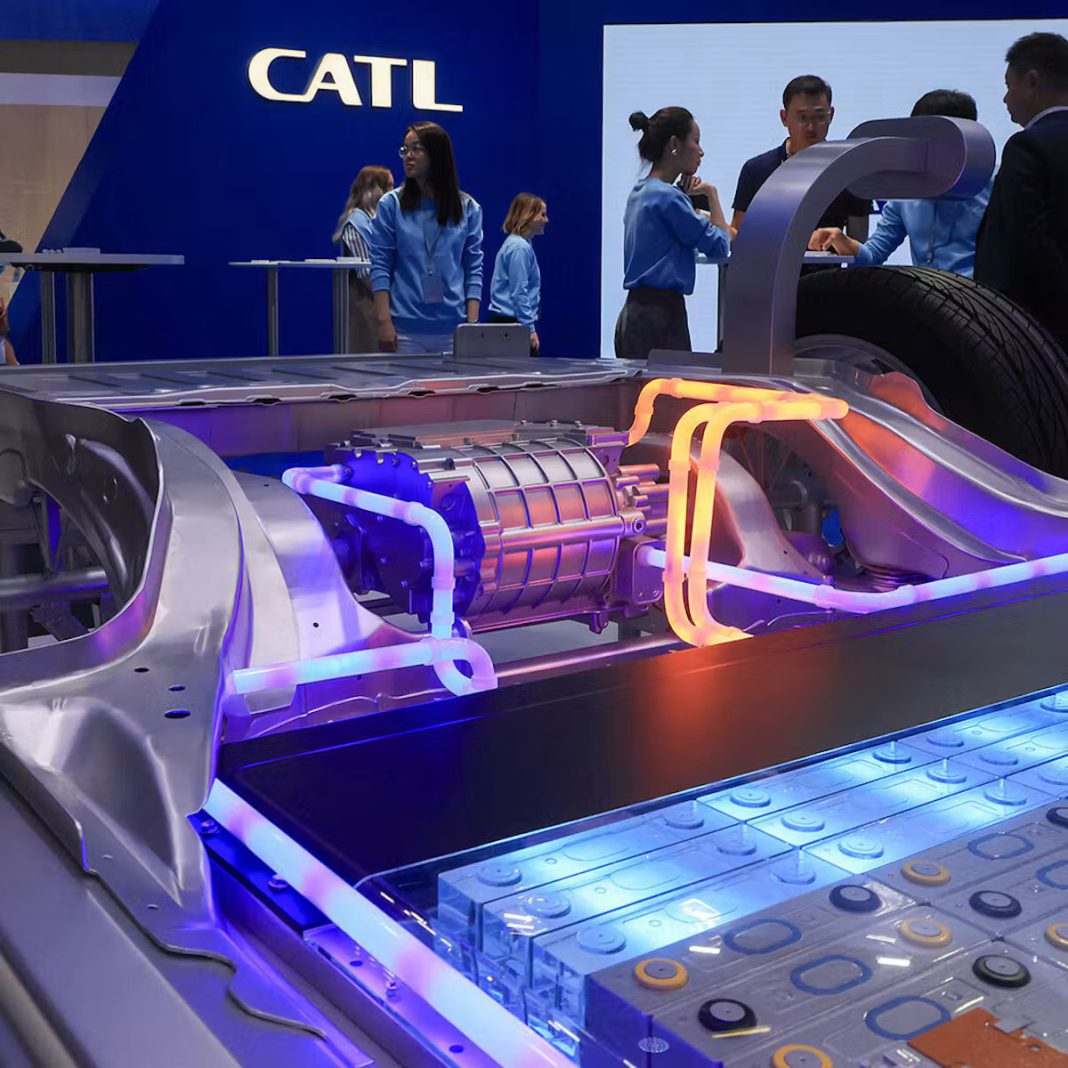

Electric vehicles (EVs) are mobility products powered partially or completely by an electric motor instead of relying on a combustion engine to cover driving range. These vehicles are gaining global attention and are always on the consumer’s mind when purchasing a vehicle because of the benefits they provide.
The advantages of an electric vehicle over fuel-powered cars include zero exhaust emissions, higher energy efficiency, lower noise pollution, and reduced petroleum imports due to domestic charging grids. Because of these advantages, Governments across the world promote the use of electric vehicles through subsidies, tax incentives, emissions rules, and industrial policies.
Electric vehicle (EV) efficiency is defined as the amount of energy converted into a useful form from the energy storage devices. The useful energy in an EV is the mechanical energy delivered to the wheels to propel the car forward, excluding energy lost as heat, friction, electrical resistance, or rolling drag.
The efficiency of an electric vehicle is measured in watt-hours per kilometre (Wh/km), which measures the energy consumed while travelling 1 km. A lower Wh/km figure indicates that the product is highly efficient and covers more distance using the same amount of energy compared to less efficient EVs. Understanding these factors helps engineers design more efficient electric powertrains to deliver better performance without adding external components.
Understanding EV Efficiency: What Does Wh/km Mean?
Wh/km is a standard measurement for calculating an EV’s efficiency. It represents the energy required from sources like the battery or the grid to cover 1 km, neglecting energy lost to heat, friction, and other losses.
For example, if an EV has an energy efficiency of 145 Wh/km, it uses approximately 145 watt-hours of electrical energy to cover every 1 km. To cover a distance of 100 km, the vehicle’s energy consumption will be 14.5 kWh.
The relationship between energy consumption and distance covered can be expressed using the formula as shown below:
Energy Consumption (kWh) = Wh/km * Distance (km) / 1,000
Imagine you are driving an electric scooter to cover a distance of 145 km, and your vehicle has an energy efficiency of 160 Wh/km. To calculate total energy consumption by the scooter, multiply the efficiency by the distance.
160 * 145 = 23, 200 Wh
Divide the total energy by 1000 to obtain the energy in kWh
23200 / 1000 = 23.2 kWh
Result: The total electrical energy consumed by electric scooter to cover a distance of 145 km is 23.2 kWh.
Use the following method to calculate the driving range.
Driving Range = Usable Battery Capacity / Energy Consumption per km
Using the above data to calculate the driving range.
23,200 Wh ÷ 160 Wh/km = 145 km
The real-world uses of energy efficiency involve estimating battery range, calculating trip cost, and comparing vehicles. An electric two-wheeler might consume 40-50 Wh/km, whereas a compact electric SUV typically uses 140-180 Wh/km.
Regenerative Braking: Recovering Energy During Deceleration
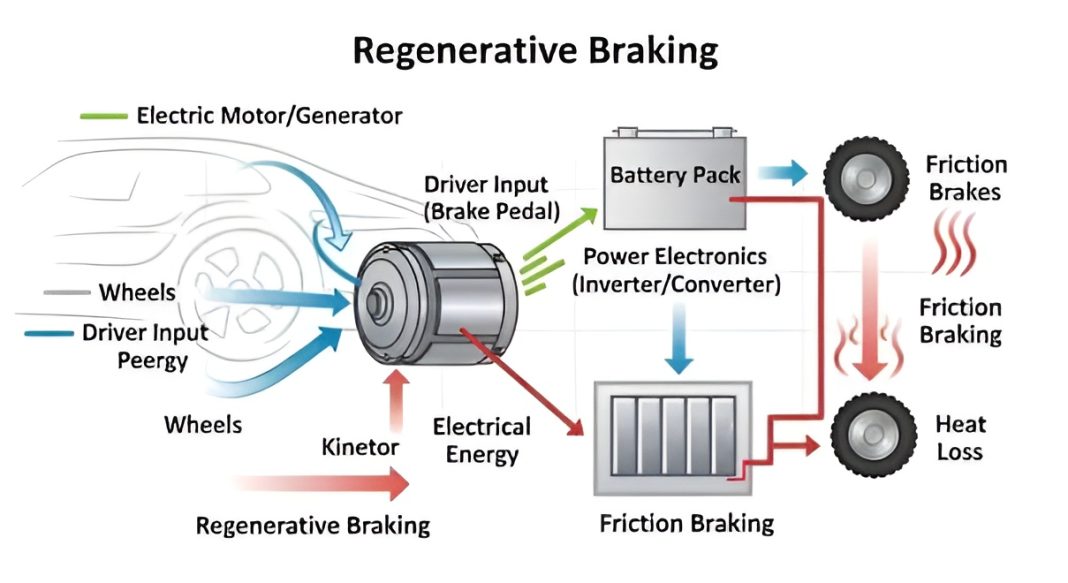
One of the most advanced features of electric vehicles that is missing in fuel-powered vehicle or vehicle that operates on combustion engine is the ability of an electric vehicle to produce energy while slowing down by applying brakes or deceleration. Fuel-powered cars turns motion into wasted heat through friction brakes, while EVs capture kinetic energy produced while applying brakes and stored in a form of electrical energy to be utilize for covering additional miles. The converted electrical energy is stored in the electric vehicle’s traction battery pack.
Electric vehicles use their electric motor to restore energy by acting as an electric generator during deceleration. Given below is a list of several steps involved in the energy recovery process.
- Pressing Brake Pedal: When the driver applies the brakes, the vehicle’s control system signals the drivetrain to stop supplying power to the wheels.
- Wheels Drive the Motor: During deceleration, while the vehicle is still moving forward, the momentum of the spinning wheels drives the electric motor’s internal shaft (rotor) to keep rotating.
- Motor Acts as a Generator: The spinning magnetic field inside the motor passes through the stator, inducing an electric current. This induced current creates electromagnetic resistance, which reduces the wheels’ rotating speed without using physical brake pads.
- Inverter Converts the Current: EV motors operate on alternating current but the energy stored inside the battery pack is in the form of direct current. During braking, the motor switches its role and acts as a generator; the bidirectional inverter rectifies the generated AC back into DC.
- Battery Stores the Energy: The electrical energy converted into DC form by the inverter flows back into the high-voltage battery pack, recharging it to cover additional range beyond the motor’s efficiency.
Aerodynamics: How Air Resistance Affects EV Range
Aerodynamics in an electric vehicle defines the flow of air around the vehicle’s body when it is moving at a particular speed, directly governing drag, stability, cooling, and driving range. On increasing the speed of a vehicle, the aerodynamic resistance also increases simultaneously.
Aerodynamic resistance is the force that directly comes from air that pushes back against a vehicle’s motion in the opposite direction, affecting the vehicle’s speed and performance. The aerodynamic drag force can be calculated using the formula shown below:
F = ½ × ρ × Cd × A × v²
Where:
- F = Aerodynamic drag force
- ρ = Air density
- Cd = Coefficient of drag
- A = Vehicle frontal area
- v = Vehicle speed
The coefficient of drag (Cd) is a dimensionless, unitless number that measures how much resistance an object experiences as it moves through air. A lower Cd coefficient reflect the lesser amount of dynamic resistance, assuming other factors remain unchanged.
Manufacturers can reduce the aerodynamic resistance of the vehicle by using several design features such as:
- Sloping rooflines and streamlined body parts.
- Smooth underbody panels to reduce airflow turbulence.
- Flush door handle and carefully design side mirrors.
- Aerodynamically optimised wheels.
- Active grille shutters that control airflow through the front of the vehicle.
Thermal Losses: Understanding Heat Loss in EVs
The process of converting electrical energy from the battery source to mechanical energy that drives the wheels involves the coordination of several components of a vehicle such as the inverter, electric motor, transmission and drivetrain. The components are not 100% efficient in converting energy into a usable form, following the Second Law of Thermodynamics, which states that every transfer of energy from one source to another involves the generation of unwanted waste heat.
Engineers reduce thermal loss by using thermal management techniques such as liquid cooling loops, airflow controls, and cabin insulation. They also use several methods to reduce heat loss besides thermal management such as designing highly efficient electronics, lowering internal resistance, optimising the drivetrain and motor to convert available energy into useful form as much as possible, and reusing the generated heat by converting it into a small portion of auxiliary electricity instead of wasting energy.
Conclusion
You can think of efficiency as how well you use the energy stored in the battery to move the vehicle with the least amount of energy wastage through the powertrain. Wh/km is a handy unit to refer to energy usage, and regenerative braking captures some energy that would otherwise be lost.
As EV technology progresses, manufacturers are exploring more efficient power semiconductor devices, better battery chemistry, lighter vehicle body structures, advanced thermal management and intelligent energy management.
In the end, boosting the efficiency of EVs isn’t about slapping in a bigger battery pack. It’s about getting more mileage out of each unit of energy to enable electric vehicles to go further while consuming less and performing better.