
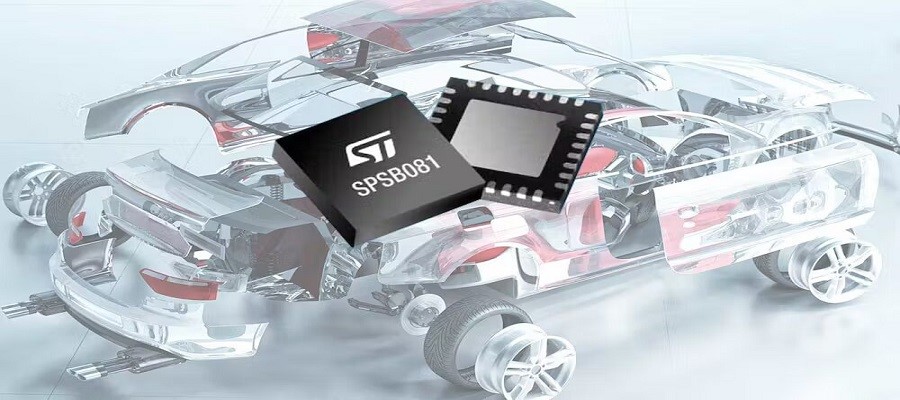

In a bid to streamline the development of car-body controllers, the automotive industry is intensifying efforts to bolster vehicle architectures in the context of increasing automation and electrification. These innovations are aimed at making electric vehicles (EVs) more appealing to consumers by optimizing energy management.
STMicroelectronics has introduced the SPSB081, a power-management integrated circuit (PMIC) that enhances the capabilities of electronic control modules. The SPSB081 PMIC boasts several features, including various standby modes that minimize power consumption, programmable local and remote wake-up capabilities, and support for LIN (only for SPSB0815 and SPSB0813) and CAN FD physical communication layers.

The primary objective of the SPSB081 chip is to simplify the design of car-body controllers, addressing functions such as sunroof operation, seats, tailgate, doors, and lighting modules. Remarkably, these controllers exhibit adaptability for use in various other applications, such as gateways, HVAC controllers, passive keyless-entry systems, telematic control units, and control panels.
Key Features and Specifications:
- The device includes a low-drop voltage regulator for the system microcontroller and a voltage tracker for external peripheral loads like sensors.
- V1 provides a fixed rail with overvoltage detection and protection, while V2 serves as a programmable tracker voltage regulator for the system microcontroller.
- It features four high-side drivers for LEDs and sensors with short-circuit protection and open-load diagnosis.
- Utilizes the ST standard SPI interface for device control and software development.
- Offers low quiescent current (typically 15 µA in standby modes) to minimize power consumption.
- Contains two low-drop voltage regulators (LDOs) for the system MCU and external peripherals.
Variants of the PMIC:
- SPSB081C3 and SPSB081C5, which include a 3.3- or 5-V fixed LDO with one CAN transceiver.
- SPSB0813 and SPSB0815, which add an LIN transceiver.
The secondary LDO in all variants can be programmed via the IC’s SPI port to function as an independent 3.3- or 5-V regulator or to track the main LDO. The high-side drivers can supply up to 140 mA to power LEDs and sensors, with current monitoring and a 10-bit pulse-width-modulation (PWM) timer for each channel.
The SPSB081 series provides solutions for electronic platforms requiring different rails and peripherals, offering a total of eight different output voltages. While not primarily designed as a safety hardware element, the device does include features that can support applications with functional safety requirements as per ISO 26262. It offers built-in protection mechanisms and a diagnostic output pin for fail-safe signalling, including overcurrent protection and open-load fault indication. The primary LDO has overvoltage and thermal protection, while the secondary LDO offers overload, overtemperature, short-circuit, and reverse-bias protection, with short-to-ground monitoring.
Applications for the SPSB081 include MCU supply, body control modules, HVAC systems, NFC car door access, and sunroof modules. The SPSB081 family is AEC-Q100 qualified, specified to operate from -40°C to 150°C, and can withstand temperatures up to 175°C. All variants are in production and available in a thermally enhanced 5- × 5- × 1-mm QFN32L package, with pricing starting from $1.80 for orders of 1,000 pieces.


 that enhances the capabilities of electronic control modules.)