
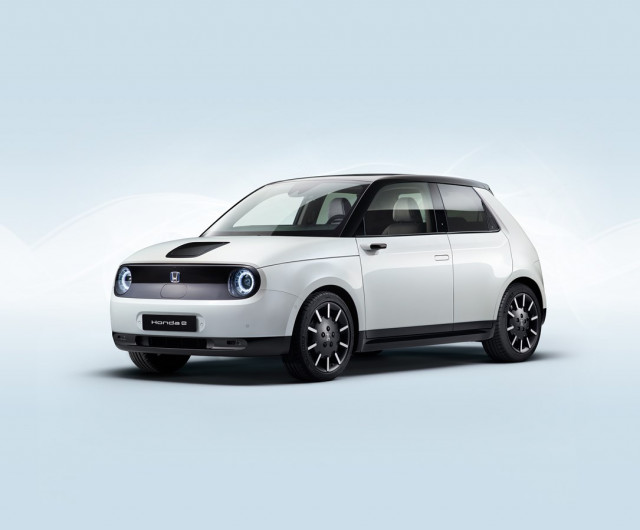
Honda to Introduce 30 EVs with $40 billion Investment by 2030

Automaker Honda has announced plans to launch 30 electric vehicle (EV) models globally by 2030 -a full line-up from commercial-use mini-EVs to flagship-class models — with production volume of more than 2 million units annually.

Over the next 10 years, Honda will allocate approximately 5 trillion yen ($40 billion) in the area of electrification and software technologies to further accelerate its electrification, including both R&D expenses and separate investments.

Honda’s overall R&D expenses budgeted for this period will be approximately 8 trillion yen, the company said in a statement late on Monday.

“Honda will build a demonstration line for the production of all-solid-state batteries with an investment of approximately 43 billion yen and further accelerate the research with a goal to start demonstration production in Spring 2024,” said the company.

The key challenge in the EV era is the global procurement of batteries.

Honda said it will ensure stable procurement of liquid lithium-ion batteries in each region by strengthening the external partnership.

Honda will introduce products tailored to the market characteristics of each region (North America, China and Japan).

In 2026, the automaker will begin adopting Honda e: Architecture, an EV platform that combines the hardware platform and software platform.

Through the alliance with GM, company is planning to introduce affordable EVs in 2027, with a cost and range that will be as competitive as gasoline-powered vehicles, starting from North America.

Hot this week

Top 10 Sodium-Ion Battery Companies for Electric Mobility

Sodium-ion batteries are rechargeable batteries made of a cathode,...

L&T Technology Services Introduces SDVault.ai, an AI-Powered Toolchain for Software-Defined Vehicles

L&T Technology Services announced the launch of SDVault.ai on...

EV Efficiency Explained: Wh/km, Regenerative Braking, Aerodynamics and Thermal Losses

Electric vehicles (EVs) are mobility products powered partially or...

CATL Explores Lithium-Air Battery Technology to Advance Next-Generation Electric Vehicles

​CATL, the world’s largest manufacturer of energy storage batteries,...

KAIST Develops Semiconductor-Based Interface Technology to Extend Anode-Free EV Battery Life

Researchers from the Korea Advanced Institute of Science and...

Topics

Top 10 Sodium-Ion Battery Companies for Electric Mobility

Sodium-ion batteries are rechargeable batteries made of a cathode,...

EV Efficiency Explained: Wh/km, Regenerative Braking, Aerodynamics and Thermal Losses

Electric vehicles (EVs) are mobility products powered partially or...

CATL Explores Lithium-Air Battery Technology to Advance Next-Generation Electric Vehicles

​CATL, the world’s largest manufacturer of energy storage batteries,...

KAIST Develops Semiconductor-Based Interface Technology to Extend Anode-Free EV Battery Life

Researchers from the Korea Advanced Institute of Science and...

GÖPEL Electronic Joins Automotive SerDes Alliance to Support ASA-ML Automotive Networking

High-speed communication technologies are becoming increasingly important in modern...

Hyundai Motor Group Outlines AI-Driven Roadmap for Electric and Autonomous Vehicle Technologies

​Hyundai Motor Group showcased its future mobility technology at...

Infineon and Qualcomm Partner to Advance Central Computing for Software-Defined Vehicles

​Infineon and Qualcomm Technologies have signed a collaboration agreement...

Related Articles

Popular Categories