
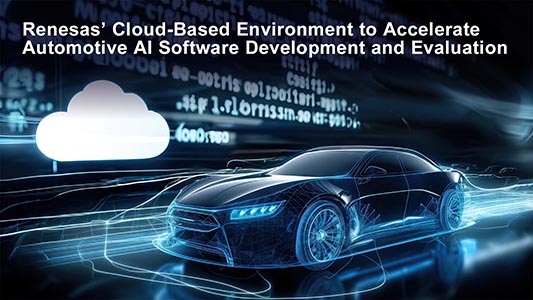

Renesas Electronics Corporation, a leading provider of advanced semiconductor solutions, has unveiled a revolutionary cloud-based development platform, AI Workbench, in collaboration with Microsoft. This integrated virtual environment is designed to enhance the efficiency of automotive AI engineers by simplifying the software design process.
AI Workbench allows engineers to design, simulate, and fine-tune automotive software seamlessly within the cloud. Leveraging Microsoft Azure services, including Azure Compute, IaaS services, Microsoft Entra ID, and Azure Security, engineers can initiate software design tasks such as performance evaluation, debugging, and verification through online simulation tools. This innovative approach aligns with the “Shift-Left” strategy, enabling software creation and testing earlier in the design cycle, even before the hardware becomes available.
Mandali Khalesi, Global VP, of HPC AI and Cloud Technology at Renesas, expressed enthusiasm about the collaboration with Microsoft, stating, “We are thrilled to introduce a cloud-based virtual development and AI model performance testing environment for automotive AI engineers. We are committed to improving the AI development environment through new features such as continuous monitoring and analysis of software usage.”
Ulrich Homann, Corporate Vice President & Distinguished Architect, Cloud + AI, Microsoft, emphasized the significance of cloud-based development in addressing the complexities of embedded projects. He stated, “The collaboration between Renesas and Microsoft aims to tackle this challenge and accelerate the digital transformation of the automotive industry.”
Key Features of the AI Workbench:
1. Upgraded AI Compiler Toolchain:
Renesas introduces the Hybrid Compiler (HyCo) architecture, enhancing the SoC AI compiler toolchain. This architecture enables engineers to broaden AI model and ONNX operator coverage beyond existing third-party hardware accelerator compilers.
2. AI Model Performance Testing Environment:
The platform includes NNPerf, an online test environment allowing developers to evaluate AI model performance on live Renesas SoCs. Testing occurs on real hardware in Renesas’ global device farm, eliminating the need for evaluation boards. Engineers can perform real-time inference tests, batch code programs, and compare performance across different AI models.
3. Software Development Environment:
Microsoft’s Visual Studio Code (VSCode) and Renesas’ software development kit (SDK) are available in the cloud. Developers can launch their development environment in minutes, customizing it using a web browser on their PC.
4. Software Evaluation/Verification Environment:
Renesas provides an environment for developers to test and verify application software using AI models defined in the NNPerf tool. Simulators like SILS (Software in the Loop Simulator) and HILS (Hardware in the Loop Simulator) allow users to verify the operation designed for their specific AI application.
Renesas plans to enhance the AI Workbench with additional features in the future, catering to various development processes and customization options. The collaboration aims to propel the automotive industry into a new era of digital transformation by providing secure, cost-effective, and efficient cloud-based development solutions.