
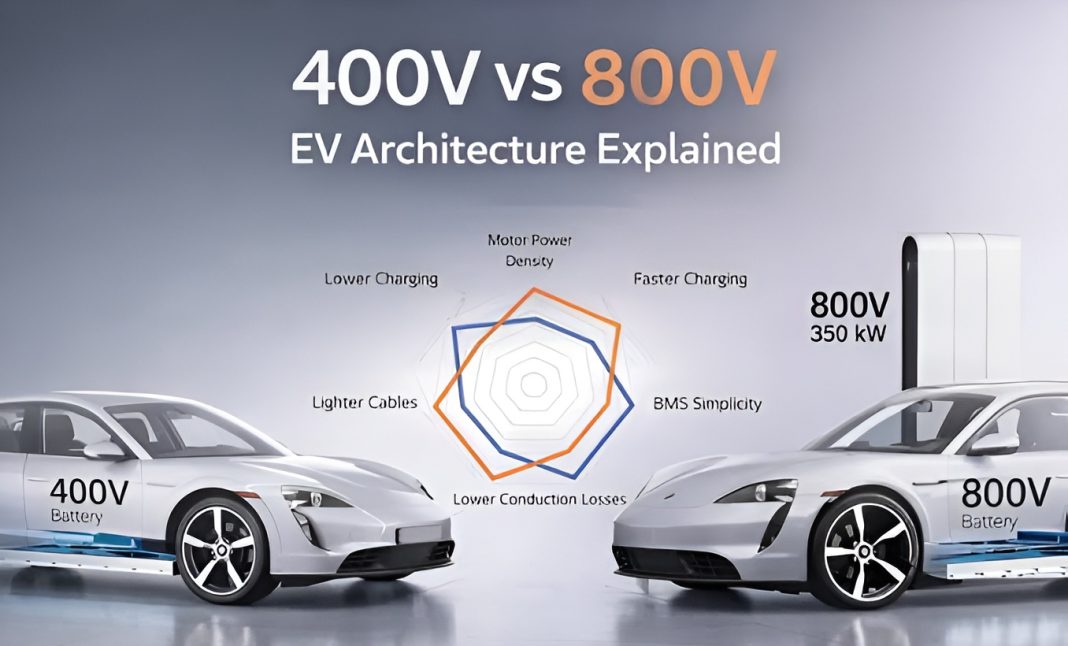

An EV architecture voltage is the core internal high-voltage electrical system of an electric vehicle, including the battery packs, inverter, motors, and power electronics, rather than the speed of an external charging station. Some of its key characteristics include the power and current relationship, faster charging speed, thermal efficiency, component cost and complexity and auxiliary separation. An EV’s high-voltage architecture determines how fast the car charges, how hot its components get, and how heavy its internal wiring is. Automotive manufacturers, pioneering brands, Tier-1 suppliers and engineering firms design it.
Electric Vehicle (EV) architecture voltage is primarily divided into two categories, which are 400 V and 800 V because of the balance between manufacturing cost, physics, component maturity, charging efficiency, and industry standards. Understanding the difference between 400 V and 800 V EV architecture is important for EV buyers, fleet operators, automotive engineers, and charging infrastructure planners because it directly impacts charging speed, vehicle weight, thermal management, and long-term vehicle efficiency.
400 V vs 800 V: Key Differences
400 V EV architecture requires double the current compared to 800 V EV architecture to deliver the same amount of power. Given below is the table describing the difference between 400 V and 800 V EV architecture.
| Parameters | 400 V architecture | 800 V architecture |
| Current at the same power | Higher current flows inside the electrical components | Lower or almost half of the current flows compared to 400 V architecture. |
| DC fast-charging potential | Slower and up to 150-250 kW | Faster and support higher charging power (350+ kW) |
| Cable and busbar requirements | Thicker conductors are required because lower voltage demands higher electrical current to deliver the same amount of power. | Smaller and lighter conductors are required to route electrical current from the battery pack to the motor, inverter, and auxiliary system. |
| Electrical losses | Higher resistive losses because power is directly proportional to current and the current value is higher in 400 V architecture. | Lower resistive losses under optimum conditions. |
| Component Cost | Lower component cost because the technology is mature, widely manufactured, and depends upon standard semiconductor and electrical parts. | Component cost is higher because of advanced technology, higher safety requirements, advanced materials, and insulation standards. |
| Charging Compatibility | Broad compatibility with standard AC charging and DC fast chargers but cannot fully utilize the maximum power output of newer 800 V ultra-fast charging stations without specialized DC-DC step-up converters. | Faces charging compatibility limits because most installed public DC fast chargers operate on a 400 V standard and require voltage-conversion hardware. |
| Typical application | Mainly serves as the industry standard for mainstream and cost-effective electric vehicles. | Typically used in electric vehicles that demand ultra-fast DC charging, high power density, and sustainable high- performance without overheating. |
Conclusion
The 400 V architecture will remain in the EV market, though its role is shifting towards budget-friendly and specific use cases as higher-voltage systems (800 V) take over the premium segment. Shifting towards higher-voltage EV architecture provides benefits like lower current for higher power, extreme fast-charging speeds, further weight and space reduction, and better thermal management.
Currently, EV architecture is beginning to move beyond 800 V systems. Some big car manufacturing companies such as Lucid Motors (924 V), NIO (925 V ET9 platform), and BYD (1000 V Super E platform) have started the production of electric vehicles operating between 850 V and 1000 V architecture that pushes past the standard 800 V threshold to drastically cut down charging times and provide extreme power density, efficiency, and scalability.