
Advanced driver-assistance systems are often described through a familiar list of features: forward-collision warning, automatic emergency braking, lane-departure warning, blind-spot information and driver monitoring. The list makes the technology sound transferable. Fit the sensors, load the software and the vehicle is ready. Valeo’s locally manufactured commercial-vehicle system demonstrates why India-specific validation, scalable sensor fusion and cost engineering matter.
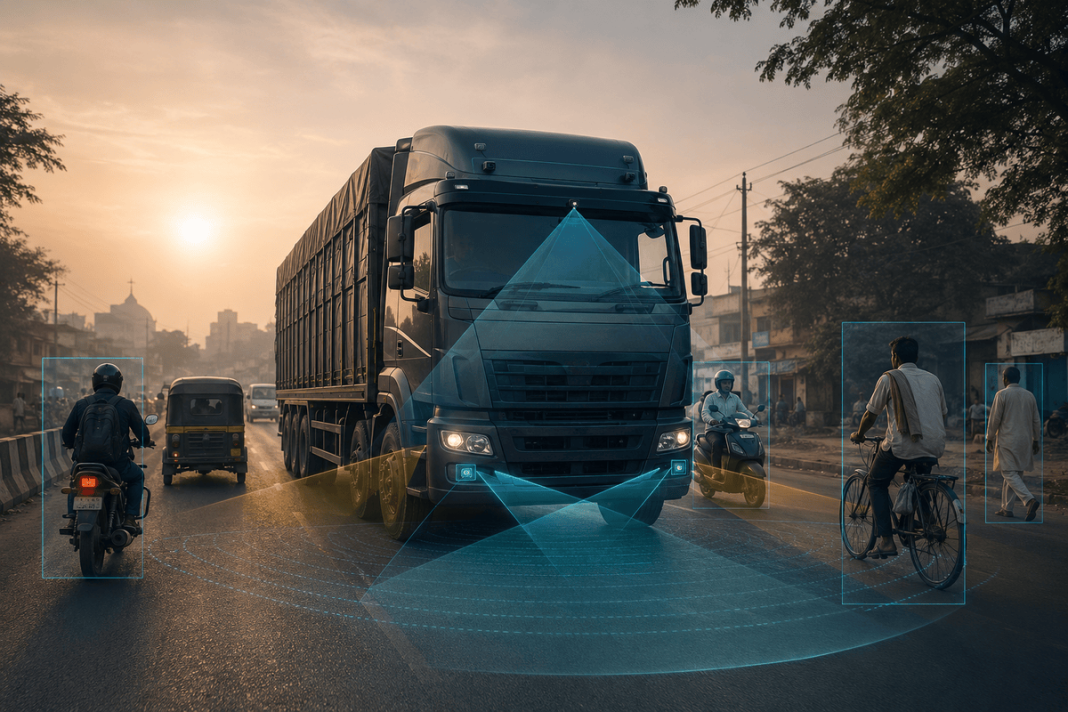
Indian roads expose the weakness in that assumption. Traffic includes vehicles with very different speeds and dimensions, vulnerable road users can enter the path suddenly, lane markings may be inconsistent and commercial vehicles operate through dust, heat, heavy loads and long duty cycles. ADAS must be engineered and validated for that environment—not merely imported into it.
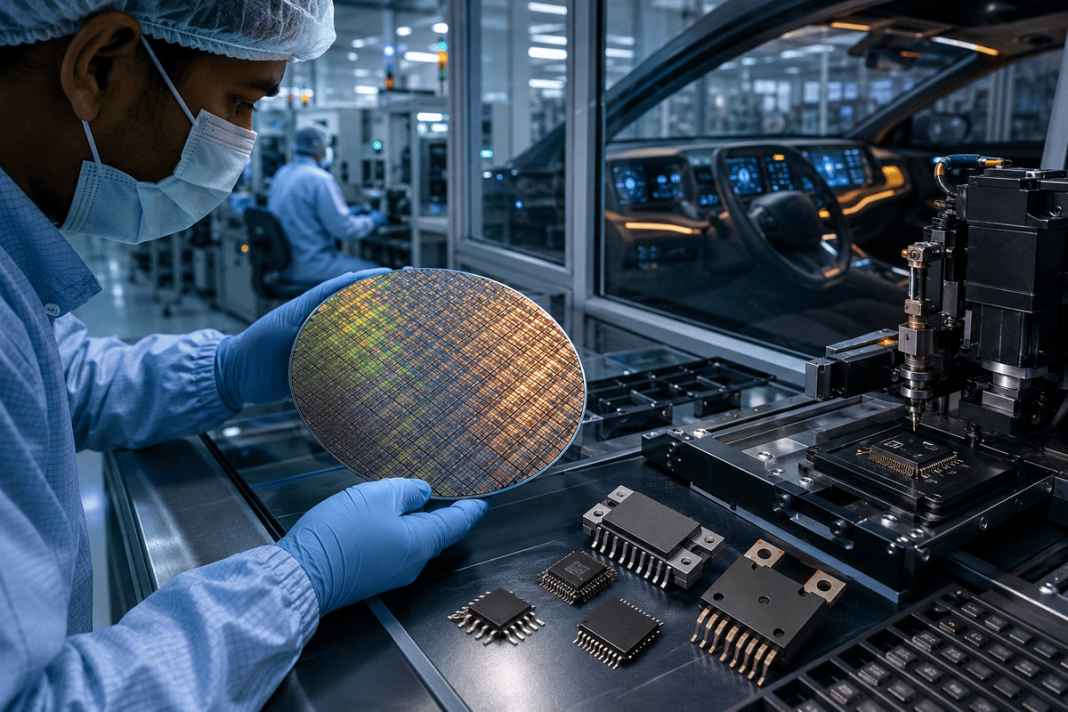
Valeo’s VSS360 nomination by a leading Indian automaker is a useful case study. The one-box system is tailored for Indian commercial vehicles and will be manufactured in Sanand, Gujarat. It combines three radars with a smart front camera, integrating radar fusion into the camera unit, and supports both 12-volt and 24-volt platforms from light commercial vehicles to heavy-duty trucks.
India-specific ADAS is not a reduced version of a global system. It is a different optimisation problem shaped by traffic behaviour, vehicle economics and operating reality.
Commercial Vehicles Change the Safety Equation
A truck driver has significant blind zones and a long stopping distance. Pedestrians, cyclists and two-wheelers can be difficult to detect near the vehicle, especially during low-speed movement or turning. VSS360 includes moving-off and blind-spot information systems alongside forward-collision warning, automatic emergency braking, lane-departure warning and driver drowsiness or attention warning.
These functions address different moments of risk, but their performance depends on accurate perception and careful human-machine interaction. A warning that arrives too late is ineffective; one that triggers too often may be ignored. Automatic braking must recognise genuine danger without creating unexpected behaviour. Driver monitoring needs to account for real cabin conditions and working patterns.
Why Sensor Fusion Matters
Cameras provide rich visual information and can interpret lanes, signs and object classes. Radar is effective at measuring distance and relative speed and can remain useful in conditions that challenge vision. Combining the two can improve confidence, but fusion is not simply a matter of adding sensor outputs. Engineers need algorithms that reconcile disagreement, manage uncertainty and maintain stable tracks in dense, mixed traffic.
The one-box approach is important for commercial adoption because integration cost matters as much as feature capability. Consolidating processing and supporting multiple vehicle-voltage architectures can make one platform usable across a broader product range. That creates scale for the OEM and a more manageable validation and service burden.
Local Manufacturing Must be Paired with Local Learning
Manufacturing in India can improve supply responsiveness and cost control, but the bigger advantage comes when localisation includes data, calibration, testing and engineering decisions. Indian traffic edge cases need to be represented in development datasets. Sensors must be evaluated across regional weather and road conditions. Warning strategies need feedback from commercial drivers and fleet operators.
Valeo says the platform supports over-the-air updates. That can allow algorithms and features to improve after deployment, but OTA also creates obligations: cybersecurity, software traceability, rollback plans, compatibility management and clear communication with vehicle owners. A safety feature is not just launched; it is governed throughout its operating life.
A Foundation For Scalable Safety
India’s commercial-vehicle market cannot depend on premium-car economics. The technology has to be robust, serviceable and scalable across cost-sensitive platforms. That makes local system integration, component availability and common architectures strategically valuable.
The VSS360 programme shows what meaningful localisation can look like: not just a domestic assembly line, but a system architecture chosen for Indian vehicles and Indian operating conditions. As safety expectations and regulation advance, suppliers that can combine perception performance with cost engineering and local validation will shape the next phase of ADAS adoption.