
Battery Energy Storage Systems (BESS) are vital to India’s clean energy transition, stabilizing the grid to achieve 500 GW of renewable capacity by 2030–31. With a projected 236 GWh storage demand backed by a ₹50,000 crore government incentive scheme, the urgent need to scale domestic manufacturing and alternative chemistries like sodium-ion was emphasized by industry leaders ahead of The Battery Show India.
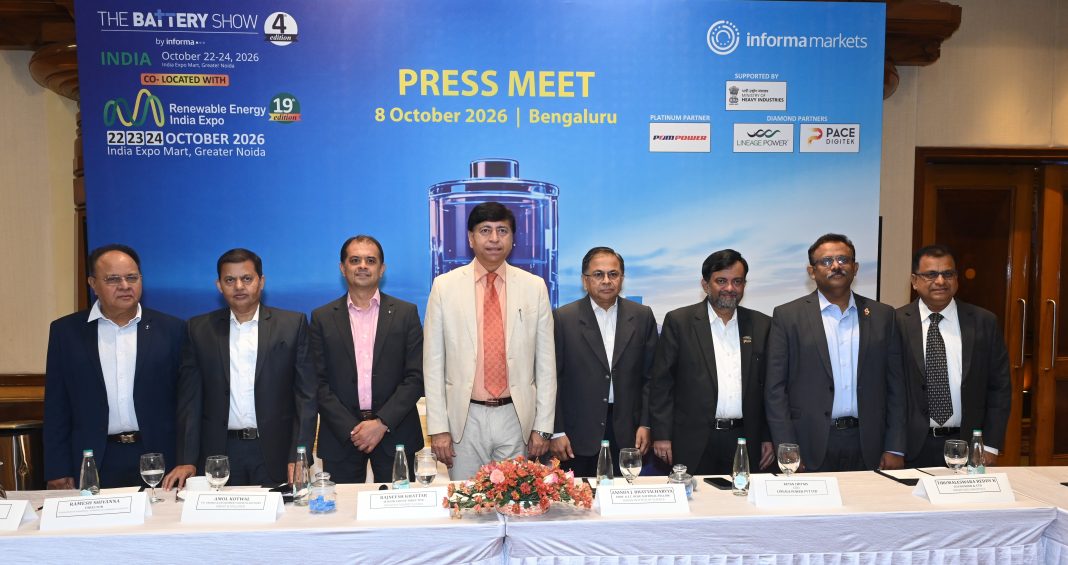
The Battery Show India, organised by Informa Markets in India, brought together senior industry and technology leaders in Bengaluru for a media roundtable ahead of the 4th edition of the show, scheduled for October 22–24, 2026, at India Expo Mart, Greater Noida. The discussion focused on scaling domestic capabilities across advanced battery technologies, grid-scale BESS, power electronics, smart-grid solutions, battery management, manufacturing and R&D, as India accelerates renewable energy integration and strengthens grid flexibility and reliability.
The roundtable featured perspectives from senior representatives across energy storage, smart-grid technology, advanced research, power systems, industrial technology, market intelligence and the broader business ecosystem. Dignitaries included Mr. Ramesh Shivanna, Director, Federation of Karnataka Chambers of Commerce and Industry (FKCCI); Mr. I B Rao, Managing Director, Pom Power Systems; Mr. Tirumaleswara Reddy K, Co-Founder & CTO, Smartgrid Analytics; Prof. Aninda J. Bhattacharyya, Professor and J.C. Bose National Fellow, Indian Institute of Science; Mr. Ketan Chitnis, Chief Operating Officer, Lineage Power Private Limited; Mr. Amol Kotwal, Vice President – Energy & Environment Growth Advisory, Frost & Sullivan; alongside Mr. Rajneesh Khattar, Senior Group Director, Informa Markets in India.
Speaking at the roundtable discussion, Mr. Ramesh Shivanna, Director, Federation of Karnataka Chambers of Commerce and Industry (FKCCI), said “Battery energy storage systems are emerging as a key enabler of India’s energy and mobility transition, supporting renewable energy integration as well as the shift from fossil-fuel vehicles to electric mobility. While around 9 GW of storage capacity has been installed so far, the potential stands at around 236 GW, creating significant opportunities for manufacturing, investment, employment and domestic supply chains. At the Federation of Karnataka Chambers of Commerce, we see strong potential for Karnataka, particularly Bengaluru, to emerge as a hub for EV and energy storage manufacturing, and have proposed dedicated mobility and EV parks with incentives for MSME manufacturers.”
Mr. Amol Kotwal, Vice President – Energy & Environment Growth Advisory, Frost & Sullivan, highlighted “India’s aggressive renewable energy expansion, with a target of 500 GW of capacity by 2030-31, makes battery energy storage systems critical for managing intermittency, ensuring grid reliability and making renewable power available when required. With renewable capacity at around 295 GW, including nearly 170 GW of solar, the need for storage will only increase. India is also moving towards greater self-reliance in BESS through three key layers, domestic cell manufacturing, local production of components such as inverters and power systems, and standardised procurement and tariff frameworks that provide long-term visibility to the ecosystem. We expect local manufacturing to scale significantly over the next few years, improving supply availability and driving greater cost competitiveness.”
Mr. I B Rao, Managing Director, Pom Power Systems & Services, said “We entered the battery energy storage market in India in 2022, when the concept was still relatively new. The sector has since evolved rapidly, and we are now seeing strong demand, particularly from Maharashtra and Karnataka. We operate primarily in the commercial and industrial segment, with systems up to 5 MW, and have already deployed a 150 kW energy storage system at ANERT, Kerala, which has been operational for 1.5 years, as well as a solar, storage and EV charging project at Bharat Electronics. At The Battery Show India, we are showcasing lithium battery-integrated EV charging systems that can support a 200 kW EV charger with just 30–50 kW of grid power, making them suitable for remote locations. We are also expanding our lithium-based UPS portfolio, including a recent 400 kW battery and 600 kW UPS order, alongside hybrid inverters, BMS solutions and BRESS systems featuring 125 kW power and 250–260 kWh batteries with liquid cooling.”
Prof. Aninda J. Bhattacharyya, Professor and J.C. Bose National Fellow, Indian Institute of Science, said “India’s energy-storage ambitions, including the requirement of around 300 GWh, make self-reliance across the battery value chain critical. While lithium-ion will continue to play an important role, we need to look beyond it at the R&D level and develop technologies that leverage materials available in India. Sodium-ion is particularly promising, given sodium’s abundance, lower dependence on critical minerals and potential cost advantage, while India also has strong research capabilities in solid-state, multivalent, aqueous and flow-battery technologies. With lithium-ion research spanning nearly 60 years, this is the right time to accelerate the development and industrialisation of next-generation chemistries.”
Mr. Ketan Chitnis, Chief Operating Officer, Lineage Power Private Limited, said “Over the last four years, The Battery Show India has evolved significantly, reflecting the rapid growth of India’s energy-storage ecosystem and its increasing global relevance. At Pace Digitech & Lineage Power, we have already deployed 1.5 GWh of battery energy storage systems, including more than 500 MWh with MSEDCL, giving us valuable real-world data on system performance and grid requirements under Indian conditions. This experience has reinforced that there is no one-size-fits-all battery technology: lithium-ion and sodium-ion can serve different applications depending on response time, duration and lifecycle requirements. At the same time, recent global supply chain disruptions underline the need for localisation, particularly for critical components. We are therefore focusing on application engineering, indigenously developed PCS and EMS, grid-forming solutions and next-generation battery technologies through our R&D centre in Pune.”
Mr. Tirumaleswara Reddy K, Co-Founder & CTO, Smartgrid Analytics, said “Renewable energy generation is inherently variable, making it challenging for power plants to meet their committed schedules and often exposing them to higher Deviation Settlement Mechanism (DSM) penalties. Battery energy storage systems can play a critical role in addressing this challenge by balancing over- and under-injection, stabilising grid operations and enabling plants to meet their committed power schedules. At Smartgrid Analytics, we have already supported around 95 GWh of renewable energy deployments and nearly 9 GWh of BESS deployments across 21 countries and 21 grid codes. Our AI-based ARA platform combines renewable generation forecasting, BESS sizing, price forecasting and 15-minute scheduling to optimise battery charging and discharging, reduce DSM penalties and improve revenue opportunities. With ARA now tested and ready for market deployment, we are also preparing to launch the solution in the coming weeks, further strengthening our software capabilities for renewable energy and BESS management.”
Mr. Rajneesh Khattar, Senior Group Director, Informa Markets in India, said “India’s energy transition is increasingly moving from renewable capacity addition to the larger challenge of integrating that power reliably into the grid. The Central Electricity Authority has projected a requirement of 236 GWh of BESS by 2031–32, while the Government’s recent approval for deploying 50 GWh of BESS under the Green Energy Corridor further underlines the scale and urgency of the opportunity. As storage becomes a core part of India’s power infrastructure, the focus will need to extend across battery technologies, manufacturing, grid integration, power management, safety and digital intelligence. Bengaluru, with its strong base of technology companies, research institutions, engineering talent and smart-grid capabilities, is well positioned to contribute to this transition.”
Bengaluru and Karnataka are emerging as an important part of this transition, supported by a strong technology, research, engineering and clean-mobility ecosystem. Karnataka had 6,805 public EV charging stations as of March 31, 2026, the second highest number among Indian states, while 1,571 additional EV chargers have been approved for the state under the PM E DRIVE scheme. Karnataka’s clean mobility policy also envisages dedicated charging and battery-swapping infrastructure along major corridors, including the Bengaluru-Pune and Bengaluru-Mysuru highways.
The city’s research ecosystem further strengthens its role in advanced energy technologies. The Indian Institute of Science (IISc) has active research programmes covering batteries, supercapacitors, fuel cells, power electronics, EV charging and battery management systems, creating opportunities for stronger industry–academia collaboration in next-generation energy technologies. The dialogue highlighted the need for an integrated ecosystem connecting battery manufacturing, BESS, renewable energy, grid management, power electronics and digital intelligence, while scaling technology, safety, manufacturing capabilities and commercial deployment in parallel.
Scheduled for October 22–24, 2026, at India Expo Mart, Greater Noida, the 19th edition of Renewable Energy India (REI) Expo is to be referred to as Asia’s most comprehensive clean energy convergence. Together, REI and TBSI form Asia’s most influential clean energy gathering, uniting global manufacturers, innovators, investors and policymakers on a platform where India’s clean energy ambitions meet global technology, capital and innovation. This edition will have over 800 exhibitors representing 1,000+ brands and an expected footfall exceeding 55,000 industry leaders, senior government representatives and distinguished global dignitaries.
The Battery Show India will feature exhibitors and brands from Korea, Japan, Germany and China, including a dedicated German Pavilion, specialised BESS Hall and companies such as CATL, Lineage Power and Hithium, POM Power System, DDEV group, IPower Battery, Bharat Cell & supported by Ministry of Heavy Industries. The show will also host 40+ conference sessions, an Energy Storage Summit, four CXO conclaves and 500+ industry speakers and moderators, alongside the Renewable Energy India Expo creating a broader platform for stakeholders across electric mobility, batteries, renewable energy and grid infrastructure.