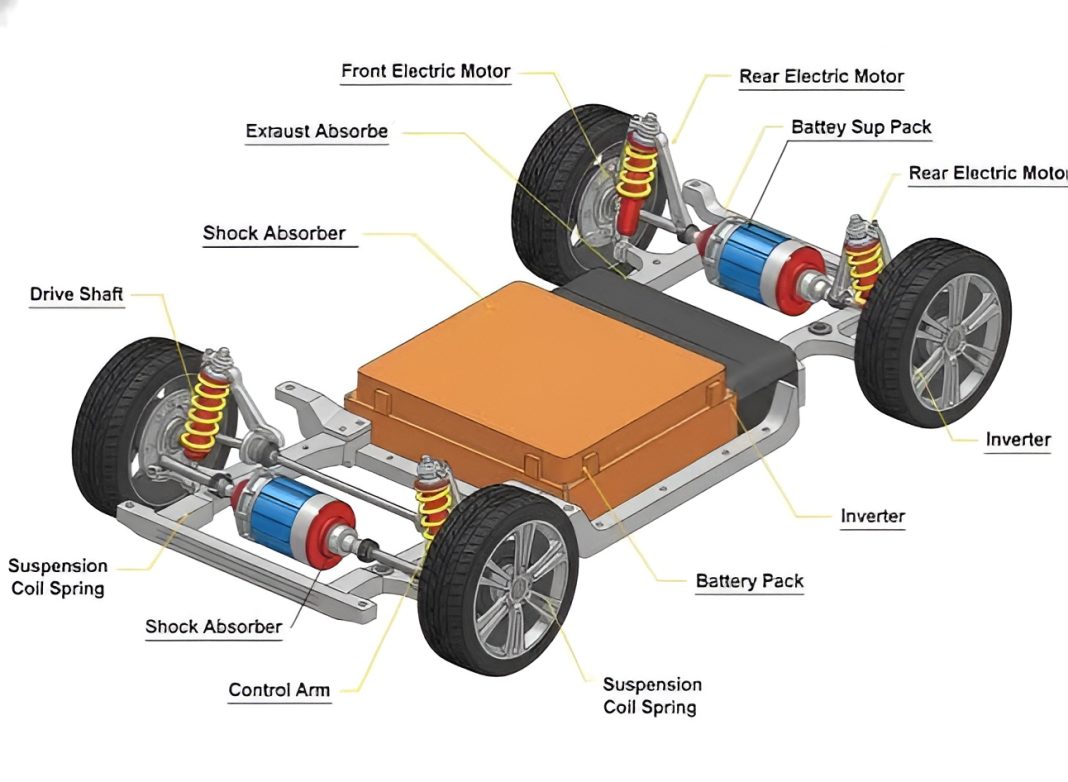

The working principle of an electric vehicle (EV) relies on electrical energy stored in a large battery pack. An electric motor converts this electrical energy into mechanical energy, delivering power to the drivetrain to rotate the wheels and create motion. The exterior of an electric vehicle looks very similar to that of a car running on fuel but the powertrain installed inside an electric vehicle works very differently compared to the combustion engine in a fuel-powered car.
A major difference between a fuel-car and an electric vehicle is that an EV can generate power while applying brakes or slowing down, converting kinetic energy into electrical energy; a fuel-powered car does not support this method.
The complete working mechanism of an EV involves coordination between several systems: the battery pack, battery management system (BMS), power electronics, inverter, electric motor, transmission, thermal-management system and vehicle control system. These systems communicate with each other to control the flow of electricity from the battery to the wheels and recover energy when the vehicle slows down.
Battery Pack Stores Electrical Energy
It is the primary energy storage device containing thousands of individual battery cells arranged into modules and assembled into a large battery pack. It uses lithium-ion battery technology because of its small size, lightweight, high energy density, and low self-discharge rate. The battery stores energy in chemical form and releases it as electricity when the vehicle requires it.
The Battery-Management System Controls the Battery
The Battery Management System is responsible for monitoring and controlling the battery pack. Its monitoring parameters include state of charge (SoC) and State of Health (SoH), which helps the BMS monitor, protect, and optimize the battery pack. To perform its functionalities, it uses a combination of hardware and software components such as cell monitoring ICs, cell balancing circuits, stack communication, and CAN bus.
Power Electronics Control the Flow of Electricity
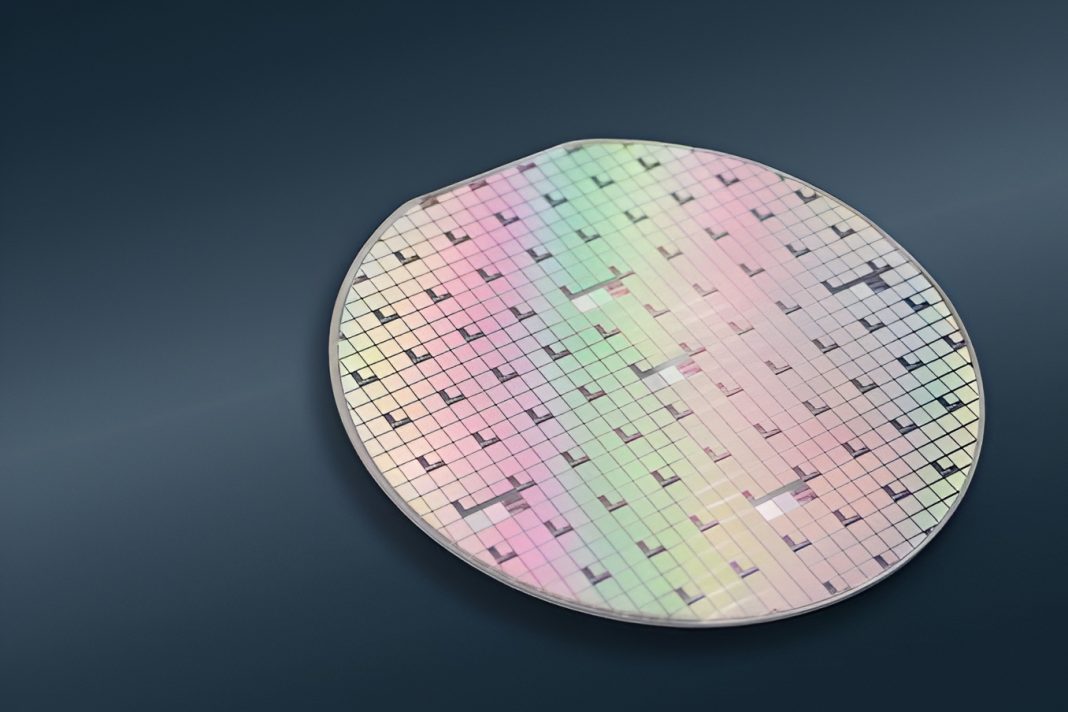
Power electronics perform switching operations by rapidly switching high-power solid-state semiconductor devices (MOSFETs, IGBTs, and thyristors) to control the flow of electric current. This method can reduce energy losses in the form of heat compared with traditional approaches that rely on resistors before advanced semiconductor switching.
Other core functionalities of power electronics include pulse width modulation to control the voltage or power delivered to the load, energy storage and filtering to manage high-power flow between the battery, electric motor, and accessories, and feedback control loops that adjust the switching frequency or duty cycle in real time to maintain stable power delivery and prevent fluctuations.
The Inverter Converts Battery Power for the Motor
The energy transferred from battery to electric motor is via inverter. It is an important link between a battery and motor that converts DC current from the battery into AC current for running the traction motor.
When the driver presses the accelerator, the vehicle’s control system determines the required power for the demanding acceleration. The inverter then converts DC current from the battery into a controlled AC waveform for the motor. When the vehicle is accelerating, the flow of energy from the battery to the wheels is shown in the given flow chart.
Battery ➔ Inverter ➔ Electric Motor➔ Transmission ➔ Wheels
The Electric Motor Converts Electricity into Motion
The conversion of chemical energy stored in a battery to mechanical energy via the inverter takes place in three phases and it also controls the frequency and voltage of the produced output alternating current (AC). The inverter uses high speed electronic switches (such as MOSFETs or IGBTs) to perform pulse width modulation (PWM). The technique shapes the electricity into AC cycles.
The produced AC cycles are then divided into three separate AC currents sent to the motor’s windings in a carefully timed sequence via the inverter. By adjusting the frequency of the AC power, the inverter dynamically controls the motor’s speed. By adjusting the voltage/amplitude, it changes the motor’s power and torque.
Transmission Transfers Torque to the Wheels
Once the rotational power is produced by an inverter, the drivetrain transfers that power to wheels by converting electrical energy into mechanical rotation. Electric motors spin at a very high RPM (revolutions per minute). Most EVs use a single-speed gearbox to drop this RPM to a lower, safer speed while multiplying the torque force. The resultant force is passed to a physical part, known as a differential, which allows the wheels on the same axle to rotate at different speeds while turning and the same speed to both wheels when driving in a straight line.
The Wheels Convert Motor Torque into Vehicle Motion
The last step is to convert the motor drive torque into work. The reduction gear and differential send the torque to the wheels. Force is created from the relationship between the rotating tires and the ground surface, which causes the vehicle to move. The vehicle’s control system constantly provides data such as wheel speed, accelerator position, steering angle and vehicle speed. This data can be used to control motor torque to achieve the best movement while driving an electric vehicle. These features make modern electric vehicles more advanced not only in terms of battery size but also in controlling torque because of integrated software, sensors, power electronics, and mechanical components that work together.
Regenerative Braking Recovers Energy
As already discussed at the beginning of this article, electric vehicles generate power while applying brakes or slowing down the vehicle. This feature is not available in a fuel-powered car. The amount of energy generated while applying brakes depends on the vehicle’s kinetic energy, which is then converted into electrical energy and stored as chemical energy in the battery.
Given below is the flow chart describing the flow of energy generated from applying brakes to storing energy in the battery:
Wheels ➔ Electric ➔ Motor ➔ Inverter ➔ Battery
The inverter transforms the created power into a form compatible with the battery, and the BMS decides whether the converted energy is accepted and how much is accepted.
Thermal Management Keeps the System Within Safe Temperatures
Temperature of vehicle components plays a crucial role in the proper operation of overall vehicle performance. The temperature of the electric motor should be maintained between 90°C and 95°C. This is the ideal temperature range for an electric vehicle to perform operations. Temperature above 100°C represents the risk state, which can cause battery damage or catch fire.
To avoid these major problems, vehicles come with installed thermal management systems which use liquid cooling and heating circuits to maintain an optimum temperature. Not only high temperatures, but also extremely low temperatures can affect battery and efficiency of an electric vehicle. The vehicle depends on onboard thermal management systems, active battery heaters, and specialised cabin-warming tech to deal with extremely cold weather conditions.
Conclusion
The operation of the electric vehicle depends on a precise sequence of energy conversions. Electrical energy stored inside the battery is regulated by the BMS; conversion and transfer of energy to the traction motor is through power electronics. An electric motor produces torque and transfers it to wheels through a reduction gearbox and differential. The primary purpose of the gearbox and differential is to turn high-speed motor power into smooth and controlled motion at the wheels.
At the same time, many operations are performed by an electric vehicle along with the working state of an engine such as thermal management for maintaining the suitable temperature, software platforms to control powertrain by coordinating with electronic control units (ECUs), power electronics, and BMS. An electric vehicle replaces a combustion engine with tightly integrated electronics, electrochemical, and propulsion systems.