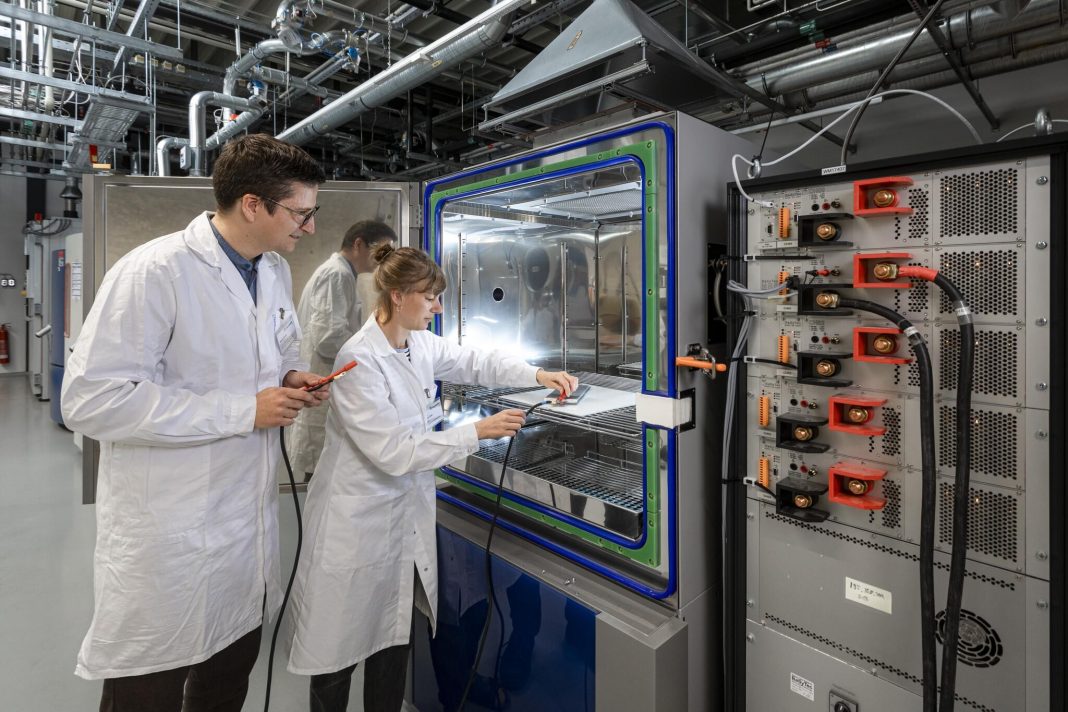

Scientists at the Fraunhofer Institute for Solar Energy Systems ISE in Germany have announced a milestone for lithium-ion batteries with high silicon content. The researchers used a battery chemistry developed in the project Str Obo Batt for a test with pouch cells, which were partially assembled by Fraunhofer ISE themselves, with a capacity of 25 Ah.
The cells retained more than 83% of their initial capacity following testing and recorded a gravimetric energy density of 280 Wh/kg in a non-optimised research-well configuration, the institute said in 20 October 2026 announcements.
Silicon could make for more powerful batteries. Silicon anodes are also capable of packing in more lithium than standard graphite anodes. More silicon could translate to a higher energy density and allow for more extended driving ranges without a heavier battery.
Main engineering challenges: silicon volume expands/ contracts significantly during charge/discharge, and cycling damages the electrode and electrical contact so that it loses capacity. The anodes must therefore be stabilised, increasing the need to engineer for longer cycle life.
Fraunhofer’s reported results demonstrate progress in balancing energy density with durability. But the cells are a research product and are not yet evidence of a commercially available EV battery. Mass production, cost, operation at various temperature conditions, and fast-charge performance are yet to be demonstrated.
What it means
If the cells can be produced at scale, they would help automakers give electric cars more range with less weight in batteries.