
The concept of an electrified powertrain to power electric vehicles was introduced to replace complex internal combustion engines with hundreds of moving parts such as transmissions, motor shafts, bearings, etc. streamlined with the battery pack, power electronics (inverter), and electric motor. It is the core physical component in an electric vehicle responsible for converting stored chemical energy inside the battery into electrical energy and then into mechanical (rotational) energy for rotating the wheels. This physical part is located flat along the floor of the chassis and controls wheel RPM by precisely regulating the amplitude and frequency of the electric current sent to the electric motor.
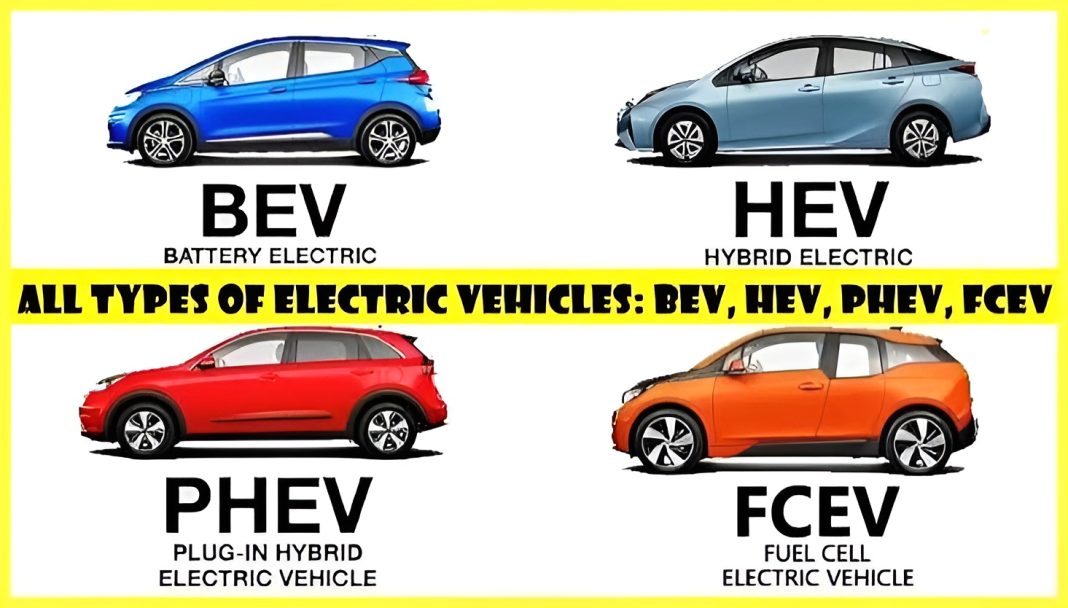
BEV, PHEV, HEV, and FCEV are the four categories of electrified vehicle powertrains, defining infrastructure realities and regional energy grids that work together to form a multi-pronged technological alliance. All four categories are installed on different kinds of electric vehicles based on driving range, charging or refuelling infrastructure, vehicle purpose/size, and cost constraints.
Battery Electric Vehicle (BEV): Fully Electric Powertrain
A Battery Electric Vehicle operates entirely on energy stored inside the battery, generating power by passing through different stages of energy conversion. This kind of vehicle completely eliminate the use of an internal combustion engine and depends solely upon the power coordination of electrical components, power electronics, and energy storage devices to perform its operations.
The stored energy inside the battery flows as DC, which the inverter converts to AC power to supply the electric traction motor. The traction inverter converts the generated raw AC power into controlled AC power using solid-state semiconductor switches arranged in a bridge configuration, driven by Pulse Width Modulation (PWM). It is then passed to a filtering stage to remove unwanted electrical noise, high-frequency interference, and to reduce voltage ripples by using capacitors, inductors, or a DC link before transferring to the load. The energy is then transferred to a single-speed reduction gearbox or transmission to obtain rotational motion.
It provides advantages such as zero emissions of harmful gases and high energy efficiency compared to fuel-powered vehicles. An EV also recharges itself while applying the brakes and its performance depends upon battery capacity, charging infrastructure, operating temperature, powertrain, and motor design.
Plug-in Hybrid Electric Vehicle (PHEV): Combining Battery Power and an Engine
A plug-in hybrid electric vehicle is a car built with the technology combining a traditional combustion engine with an electric motor and a large rechargeable battery. The energy stored in this vehicle’s battery is enough to cover a short distance of 50 to 80 km on a single charge.
While covering long distances, the combustion engine automatically turns on when the vehicle’s battery is running low or when you need more acceleration. This kind of vehicle is ideal for travelling within the city as you do not need to worry about remaining energy inside the battery. You can complete daily commuting using cheap electricity rather than fuel.
In a PHEV, a combustion engine can work together with an electric motor depending upon powertrain design, driving conditions, power demand, and battery charge level. An intelligent computer system manages both power sources using a centralised Powertrain Control Module (PCM) or Hybrid Control Unit (HCU). It is designed for consumers who want electric driving for daily commutes to save fuel costs while retaining the flexibility of a combustion engine for covering long distances.
Hybrid Electric Vehicle (HEV): Electric Assistance Without External Charging
This kind of vehicle also contains a combustion engine and an electric motor as power sources but it has a small battery pack which cannot be connected to an external charging station to recharge. The battery pack recharges automatically using the internal combustion engine and regenerative braking system.
The combustion engine is not directly connected to the wheels; instead, it drives the generator which produces electricity to refill the battery pack or directly power the electric drive motor. The combustion engine generates mechanical rotation when high-speed cruising, heavy acceleration or hill climbing is demanded, and it shuts off completely in traffic jams or when the vehicle is idle to save fuel costs.
The vehicle’s control system manages the interaction between the combustion engine, the electric motor and the battery. HEVs provide better fuel efficiency compared to other petrol vehicles and eliminate the need for external charging. It covers a shorter distance in electric-only drive mode compared to a PHEV because of smaller battery packs and is suitable for city driving conditions where frequent braking provides opportunities for energy recovery.
Fuel Cell Electric Vehicle (FCEV): Hydrogen-Powered Electric Propulsion
“Fuel cell vehicles run on clean-burning hydrogen and are three times more efficient than the traditional combustion engine. They offer an alternative approach to vehicle electrification by generating electricity onboard through a chemical reaction between hydrogen and oxygen. This technology can help reduce tailpipe emissions, improve energy efficiency and support the transition towards clean transportation.” said Albert Russell Wynn, an American politician and former member of the U.S. House of Representatives.
A Fuel Cell Electric Vehicle generates power through an onboard chemical process in which the fuel cell converts chemical energy directly into electrical energy through the following core steps:
- Compressed hydrogen (H₂) is supplied from an onboard tank and delivered to the negative electrode (the anode).
- A catalyst (primarily uses platinum) splits the hydrogen molecule into protons and electrons.
- The protons pass through a special electrolyte membrane to the positive side, while the electrons travel through an external circuit to create electricity that powers the vehicle’s electric motor.
- At the cathode side, protons combine with oxygen and returned electrons to form pure water and to complete the electrical circuit, which allows the fuel cell to keep generating power.
A fuel cell is an electrochemical device that generates electricity onboard by combining hydrogen gas and oxygen from the air. An FCEV uses electric motor to generate rotational motion similar to a standard electric vehicle but it utilises an electrochemical process to generate electricity instead of drawing power from a large battery pack. A single tank in FCEV can cover a distance of up to 480+ km and it is environment-friendly. As these vehicles come with an electric motor, they provide instant torque and smooth power similar to an EV.
Conclusion
With the increasing demand for electric vehicles, the pace of innovation is accelerating toward next-gen optimisation. Solid-state batteries are becoming a major power source for BEVs and PHEVs packs because of additional distance coverage, faster charging time, and enhanced safety compared to the current lithium-ion battery packs. The integration of artificial intelligence for predictive energy management in modern EVs is also gaining momentum as it plays an important role in extending battery lifespan and preventing thermal runaway or overloads.
Production of HEVs is scaling up, driving high-pressure fuel cell stack designs to lighter weight and higher durability, positioning FCEV as a dominant force in heavy-duty transit and long-range transport. Together, advancements in these technologies are creating a cleaner and highly unified intelligent transport ecosystem.