
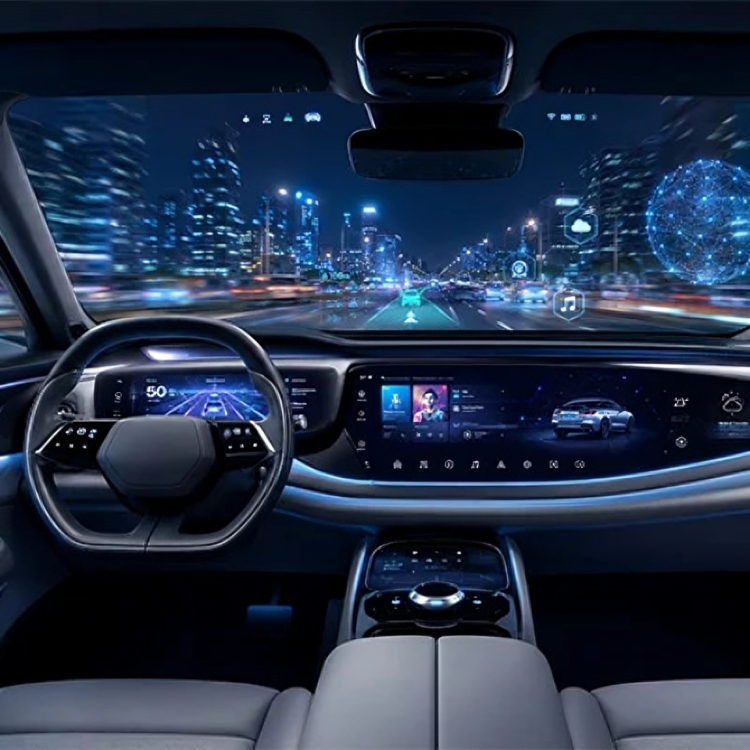

The New Generation of Smart Vehicle Cockpits
The digital cockpit of the future is coming to automotive as cars become more intelligent, more connected, more software-defined. Digital dashboards are becoming digital ecosystems with intelligent instrument clusters, infotainment, intelligent voice control, navigation, head-up displays, cockpit monitoring, and more.
By 2026, the industry will be driven by AI, high-performance computing, SDVs, OTA, and personalised driving experiences. October updates from LG Electronics, Aptiv, HARMAN, and Valeo demonstrate the industry’s rapid progress.
View the top 12 companies that are transforming automotive electronics, software, displays, connectivity, and smart cabin systems.
AUMOVIO (Formerly Continental Automotive): Advancing Intelligent Vehicle Architectures
Continental’s former automotive division became the independent company AUMOVIO in September 2025. It offers automotive electronics and displays, sensors, software, and advanced vehicle architectures.
This month, AUMOVIO reported large series-production orders in Asia for its satellite cameras, with order intake exceeding €500 million. While this feature is mainly useful in ADAS applications, it shows the company’s ongoing investment in next-generation vehicle electronics. It also confirms AUMOVIO’s continued investments in intelligent vehicle electronics.
Next Steps: AUMOVIO will focus on development of integrated vehicle electronics, software-defined architecture, sensing, and computing platforms. These technologies can enable more connected cockpits and more smarter vehicles experiences.
Robert Bosch GmbH: Introducing Generative AI to the Cockpit
Driving smarter, Bosch is expanding its AI-based cockpit technology with an AI extension platform, which it is unveiling at CES 2026. It adds next-level AI capabilities into the vehicle architecture using NVIDIA DRIVE AGX Orin.
It supports conversational interactions, contextual understanding, and in-cabin applications, including vision-language models. The company also uses NVIDIA’s software technologies and Microsoft Foundry to support AI development and application.
Markus Heyn, member of the Bosch board of management and chairman of Bosch Mobility, said: “The new AI extension platform enables existing cockpit systems to be quickly and easily upgraded with advanced AI functions.”
Next Steps: Bosch is working to make vehicle assistants more intelligent and proactive, and to enable integrated cockpit computing. The in-vehicle infotainment business with added AI will likely see sales of over €2 billion by 2030.
DENSO Corporation: Enabling Connectivity in the Cockpit with Mobility Systems
DENSO has been working on automotive electronics, connectivity, and intelligent mobility. Working with Qualcomm on next-generation cockpit systems showed that DENSO is also interested in high-performance computing combined with integrated vehicle experiences. It is also progressing its broader long-term plan, CORE 2030, which defines its mobility and technology priorities for the coming years.
Future Opportunities: DENSO has opportunities in integrated vehicle electronics, connected mobility, intelligent interfaces, and technologies that enable cockpit functions to better communicate with other vehicle systems. This will be especially valuable for automakers as they streamline their electronics architectures.
Visteon’s Future: AI Computing and Next Generation Displays
Visteon is a leading supplier of digital instrument clusters, infotainment systems, cockpit domain controllers, and advanced displays.
The company’s third-quarter business update for October 2026 announced the release of an AI-powered high performance computing system for the Chery Freeland 8 in China. Other major launches included a cockpit domain controller (for the BMW i3), an Audi Panorama display programme, and a driver display (for the Lexus TZ).
Sachin Lawande, CEO, Visteon, said, “Our HPC launch with Chery was a significant milestone for Visteon, demonstrating our ongoing position as a key supplier supporting the transition to software- and AI-defined vehicles.”
Next steps: Visteon is working on scalable AI computing, advanced display technologies, integrated cockpit software, and intelligent vehicle experiences. These features will enable makers to roll out new abilities in vehicles of all types.
HARMAN International: Smart Cockpits and Connected Safety
HARMAN creates connected and immersive experiences for automotive makers. Our technology portfolio offers solutions such as cockpit platforms, connected safety, and in-cabin experiences. Among the most significant developments in October 2026, HARMAN Ready Aware was named the Driver Safety Solution of the Year in the Auto Tech Breakthrough Awards.
Connected vehicle systems can employ Vehicle-to-Network which combines traffic, road, infrastructure, and weather data to offer situational alert information to users behind the steering wheel. It enables over 15 connected safety use cases.
Suman Sehra, HARMAN’s global head of Connectivity Product and Portfolio Management, said: “Ready Aware gives automakers a flexible way to move connected vehicle safety from reactive intervention to proactive awareness.”
HARMAN announced Thomas Irawan as COO of HARMAN Automotive, starting October 2026, further strengthening the company’s senior leadership team within its smart cockpits, connectivity, and automotive engineering lines of business.
Future Trends: In this area, software-defined cockpit services, connected safety, premium audio, and personalized in-car experiences will drive the growth of HARMAN.
Panasonic Holdings Corporation: Integrated Cockpit Computing
Panasonic Automotive Systems is creating integrated cockpit domain controllers to combine instrument clusters and head-up displays with the infotainment system.
In July 2026, its cockpit domain controller was selected for Mazda’s all-new CX-5. Features of the system include synchronised displays, voice interaction, driver personalisation and OTA updates. It also employs VirtIO virtualisation to enable scalable software development.
Panasonic Automotive Systems will now operate under the name of Mobitera Inc. from April 1, 2027.
In the Future: Panasonic will focus on development of centralised cockpit computing, software virtualisation, integrated displays, and connected vehicle experiences. These technologies can enable manufacturers to introduce upgrades over the lifecycle of a vehicle.
Aptiv PLC: Accelerating AI computing and Automated Driving
Aptiv offers industry-leading automotive software, electrical architecture, connectivity, and safety systems.
In October 2026, Aptiv and NVIDIA extend collaboration on scalable production-grade automated-driving solutions. The collaboration combines NVIDIA Hyperion and NVIDIA Halos safety technologies with Aptiv’s modular computing architecture and industrialisation capabilities.
The plan is to deploy the highly automated driving systems to a wider range of vehicles at a lower cost. Additionally, this method allows for flexible configuration of sensors, software applications, and AI models.
Looking ahead: Centralised computing, intelligent sensing, autonomous driving, and software-defined vehicle architectures will take precedence at Aptiv. May lead to cockpit, connectivity, and safety functions integration.
LG Electronics: Immersive Displays and Connected Entertainment
The company has expanded its infotainment offerings with new displays, connected content, and integrated cockpit systems.
Two big changes occurred in October 2026. Firstly, LG announced that it would supply an integrated cockpit solution for Renault Group’s New Traffic E-Tech Electric, the automaker’s first mass-produced commercial vehicles based on an SDV architecture. The cockpit solution incorporates the instrument cluster and infotainment system.
The company announced on October 8, 2026, the six in-cabin features coming to the GV90, including a 24.6-inch variable pop-up central display, integrated infotainment, LG Automotive Content Platform, and rear-seat entertainment.
Next Gen: LG’s focus areas include large adaptive screens, connected entertainment, in-vehicle computing, and personalized experience for the cabin. Its screens show us that automotive cockpits are rapidly becoming digital entertainment and information destinations.
Valeo SA: Supercomputing and Digital Twins
The company develops new software, sensors, lighting, driver assist, and intelligent mobility products for use in the automotive industry.
October 21, 2026- Valeo will create and bring to production high-performance computing platforms based on NVIDIA Hyperion for the architecture of future vehicles and autonomous-driving applications.
The other October highlight was the partnership with Anritsu. In October 2026, the companies shared a digital-twin validation demonstration for software-defined vehicles at the 5G Automotive Association meeting in New Delhi. It integrates a virtual telematics unit and a virtual cellular network to validate connected vehicle operations, such as emergency calling, independent of track-based testing.
Next Step: Valeo is working on centralised computing, digital-twin validation, vehicle connectivity, and advanced safety. These solutions will enable vehicle makers to test and implement more complex software-defined vehicle systems.
Magna International Inc.: Driver and Occupant Monitoring
Magna is an automotive engineering company specialized in mirrors, electronics, and vehicle systems. It develops cockpit-related technology such as driver monitoring and occupant monitoring.
In May 2026, Magna revealed a driver and occupant monitoring programme with a European automaker. The system within the mirror integrates a behind-the-glass camera design with software capabilities, enabling manufacturers to include monitoring capabilities, enabling manufacturers to include monitoring capability without the need for prominent cabin hardware.
Matteo Del Sorbo, president of Magna Mechatronics, Mirrors and Lighting, said: “This award reflects a growing shift in how driver monitoring is being deployed at scale — not as a standalone feature, but as part of an integrated vehicle architecture.”
Future Direction: Magna is focusing on integrated sensing, driver-awareness technologies, and software-enabled monitoring systems that can support future vehicle safety architectures.
Marelli Holdings Connecting Displays to Software-Defined Vehicles
Marelli is working on integrated cockpit systems that combine displays, computers, audio, and automotive electronics.
September 3, 2026, Marelli and Microchip Technology unveiled an open-standard automotive display connectivity solution based on ASA Motion Link. This allows graphics and video produced by the car’s main computing system to be fed directly to the screen in the vehicle.
The system can support data rates up to 16 Gbps as well as authentication and encryption. The offering is intended to enable simplified display architectures, improved interoperability, and greater flexibility in selecting technology vendors.
The company said the system supports data rates of up to 16 Gbps and provides authentication and encryption. The solution will allow display architectures to be simplified, interoperability to be enhanced, and technology suppliers to be selected more flexibly.
The next step: Marelli is looking at open-standard display connectivity, zonal architectures, next-generation displays, and integrated cockpit computing. This may provide more flexibility and scalability to software-defined vehicle systems.
Pioneer Corporation: Connected Infotainment and In-Car Audio
Pioneer is a leader in automotive audio, navigation, and multimedia receivers. Its smartphone-connected products provide entertainment and navigation to factory and aftermarket vehicles.
January 2026: Pioneer announced an aftermarket digital multimedia receiver with Dolby Atmos playback via Apple CarPlay at CES 2026.
Among other May 2026 product announcements, Pioneer also declared the offering of factory-installed car navigation systems for Suzuki’s Every and Every Wagon minivan. Its October 1 corporate declaration addressed an internal group restructuring.
Next Step: Pioneer is ready to design connected multimedia, immersive audio, navigation, and intuitive infotainment systems. Connectivity with smartphone ecosystems will stay vital for future automotive plans.
Industry Forecast for Automotive Digital Cockpit
Here, we look at five trends that could have an even more profound impact on the automotive cockpit of the future: Generative AI assistants, centralized high-performance computing, adaptive displays, driver and occupant monitoring, and secure over-the-air (OTA) software updates.
October 2026 announcements appear to indicate that they are moving from ideas. LG is working on cockpit systems for upcoming SDV programmes, Aptiv is deepening its NVIDIA partnership, HARMAN is pursuing connected safety, and Valeo is developing digital-twin validation.
But change has its challenges. Automakers are required to safeguard vehicle data, protect against cybersecurity gaps, achieve functional safety, and minimise driver distraction. These systems should offer drivers helpful information without bombarding them.
Conclusion
The automotive digital cockpit industry is shifting from conventional dashboard design to an intelligent, connected, and software-defined digital cockpit. The development of this shift is being led by players such as Bosch, Visteon, LG Electronics, HARMAN, Aptiv, and Valeo.
One day, it won’t be a question of how many screens we install in a vehicle. We will be asking, “How do all the equipment, software, AI, connectivity, and safety features come together to deliver a stable, personalised customer experience?”