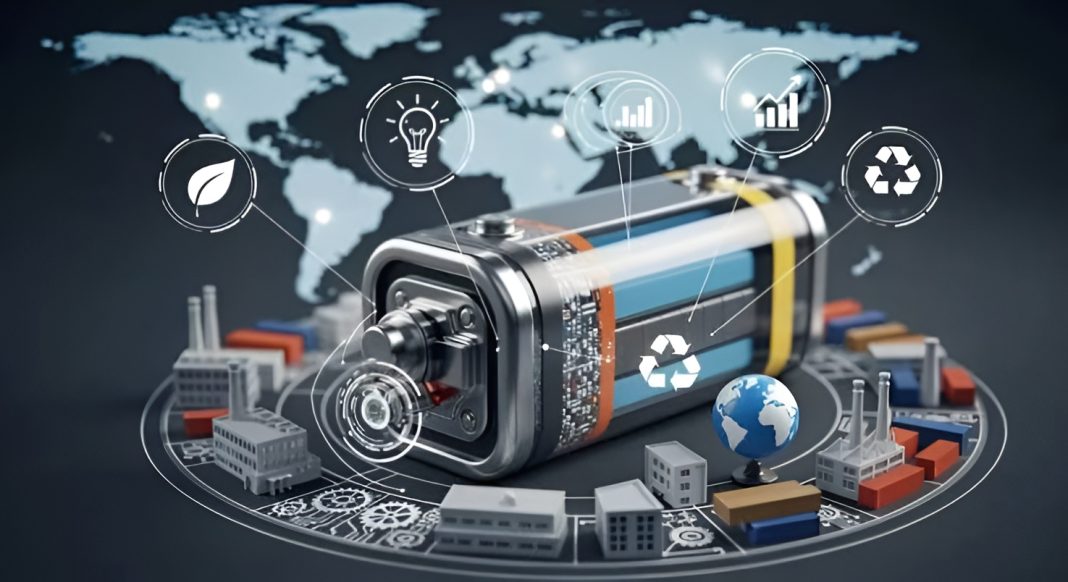

Sodium-ion batteries are rechargeable batteries made of a cathode, anode, electrolyte, separator, and current collectors that move sodium ions between the cathode (positive electrode) and anode (negative electrode) during charging and discharging. The movement of sodium ions changes between the cathode and anode during charging and discharging. Sodium ions move from the cathode to the anode through the electrolyte and vice-versa during the discharging state.
Electric mobility conventionally uses lithium-ion batteries to provide power for the majority of electric vehicles. Lithium-ion batteries provide higher energy density, and they are lightweight and have a compact design, making the device easier to fit and move. The reason for shifting from lithium-ion batteries to sodium-ion batteries is to achieve overall improved performance of energy storage devices, which could also enhance affordability, safety, and supply chain security.
As consumer demand for electric vehicles increases, manufacturers began exploring sodium-ion batteries as an alternative option to reduce reliance on costly lithium-ion batteries and replace expensive materials with abundant sodium and cheaper metals. Following is a list of the top ten companies playing an important industry role in developing sodium-ion batteries and updating existing charging solutions through advances in electrolyte chemistry, cell engineering, and existing lithium-ion production lines.
CATL (Contemporary Amperex Technology Co. Limited)
A Chinese manufacturing company developing a sodium-ion charging solution as an alternative to lithium-ion batteries for electric vehicles, commercial transportation and energy storage systems. The company has shown outstanding performance in developing sodium-ion batteries by achieving a First-generation Cell Spec that reached up to 160 Wh/kg cell energy density, 15-minute charging to 80% battery charge, and overcoming challenges in extreme moisture conditions which cause rapid chemical degradation and structural collapse in sodium-ion batteries.
HiNa Battery Technology
The company manufactures sodium-ion batteries and battery chemical components using copper-iron-manganese layered oxide cathodes and hard/soft carbon anodes. The company’s headquarters is in Liyang, Jiangsu Province, China specialising in sodium-ion battery research, cell manufacturing and energy storage solutions.
This company employs a tabless, double aluminium current collector design to lower internal resistance and improves manufacturing techniques to make sodium-ion cells more efficient and increase energy storage capacity.
BYD (Build Your Dreams)
BYD is globally recognized for manufacturing electric vehicles and charging solutions. In terms of material and electrochemistry, BYD uses highly stable polyanion materials and electrochemical refinements for the cathode and transition metal chemistries to stabilize layered transition metal oxides and suppress undesirable phase transitions.
BYD’s sodium-ion cells operate across wide temperature ranges (-40°C to 80°C) on the 3rd-gen platform and support fast charging/discharging rates paired with its Blade cell architecture. The multi-chemistry approach implemented by BYD in its sodium-ion battery technology enhances overall battery performance and balances cost, durability, extreme-weather conditions, energy density, and cycle life across different applications.
Faradion
Faradion manufactures sodium-ion battery technology for electric vehicles that lowers reliance on costly metals while offering strong safety and fast charging. The charging solution is designed to run on existing lithium-ion manufacturing lines without cobalt, lithium, or copper while targeting 30% lower cost than lithium-ion.
EVE Energy
The company commercializes high-durability NF155L sodium-ion cells built on lithium-compatible manufacturing lines. These cells use NFPP chemistry and are designed primarily for stationary battery energy storage systems (BESS) that provide thermal and fire safety by producing less flammable gas under extreme thermal runaway.
EVE Energy is also expanding its sodium-ion battery production for electric vehicles by targeting electric two-wheelers with high-durability, low-temperature cells while building a manufacturing facility in Huizhou, Guangdong Province, China, targeting 2 GWh of annual production.
Gotion High-Tech
Again, a China-based manufacturing company established with a vision of “Build an Energy Science System Based on Materials Science and Digital Science,” and carrying the mission to “Make Green Energy Accessible and Sustainable.” The company is widely popular for its sodium-ion battery technology because of its Gnascent platform launched in May 2026. The platform eliminates the use of an anode as a current receiver, enabling the flow of electric current by using an anode-free structure. This reduces manufacturing costs and increases energy density. The sodium ions release from the cathode, travel through the electrolyte, and deposit directly on the negative current collector as a thin layer of metallic sodium. This plated sodium metal immediately acts as the active anode to complete the internal electrochemical circuit.
Tiamat Energy
A French company manufacturing sodium-ion battery technology as an alternative to lithium-ion battery technology with features such as fast charging, high power density, and reduced dependence on costly materials. The technology is designed for hybrid systems, buses, and future battery electric vehicles (BEVs), and utilizes a sodium vanadium fluorophosphate (NVPF) cathode and hard carbon anode to provide structural durability along with high power output and fast charging/discharging.
Altris
Altris is a Swedish battery technology company headquartered in Uppsala, Sweden, that achieved a major milestone in commercializing sodium-ion battery technology by industrializing its proprietary France Prussian White cathode material built from abundant iron, sodium, carbon, and nitrogen. Commercial-sized cells reach around 160 Wh/kg energy density. The technology pairs the Prussian White cathode with bio-based hard-carbon anodes and a patented NaBOB electrolyte for fire resistance and low-temperature operation. The sodium-ion battery technology also lowers the emission of toxic or flammable gases under certain failure conditions compared to lithium-ion batteries.
KPIT Technologies
An Indian automotive software and engineering R&D company focuses its innovation on mobility software and engineering. The company does not have its own physical manufacturing facilities but develops technology solutions for automotive Original Equipment Manufacturers (OEMs) and Tier-1 automotive suppliers including ZF Group, Bosch, and Cummins.
KPIT Technologies focuses on software and engineering instead of manufacturing components. The company develops sodium-ion battery technology that can go through 3,000 to 6,000 full charge-and-discharge cycles before its maximum energy storage drops to 80% and offers a standard energy density ranging from 100 to 170 Wh/kg across its multiple cell variants.
Indi Energy
Indi Energy is an Indian battery technology and manufacturing company that develops sodium-ion batteries and converts agricultural waste into hard carbon anode materials to reduce reliance on imported lithium, cobalt, and nickel. The company holds around 20 patents related to biomass-derived hard carbon and sodium-ion battery technology.
Conclusion
Sodium-ion batteries are gaining significance as a second player in the global electric mobility ecosystem. Cell companies like CATL, HiNa Battery, BYD, Faradion and Tiamat are working on cell technology and manufacturing, Indian companies like KPIT Technologies and Indi Energy on research.
It is unlikely to supersede existing lithium-ion batteries for all classes of EVs in the near term. Rather, both chemistries will coexist, with the choice made depending on a given application’s energy density, price, fast-charging characteristics and operating needs.