Exicom Starts Manufacturing Liquid-cooled EV Charger Modules in India

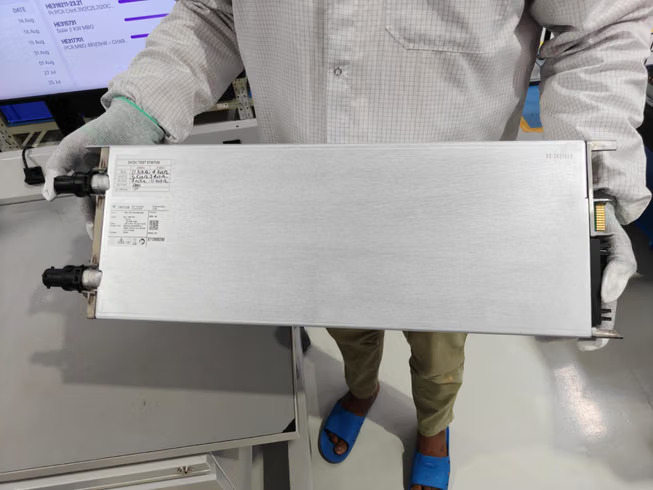
Exicom Tele-Systems has started production of liquid-cooled AC and DC power modules for EV chargers at its Hyderabad facility. The development marks a huge milestone for Indian EV chargers and power-electronics manufacturing ecosystem in India. It states that it is also the only company in India to manufacture this kind of liquid-cooled power module for markets worldwide.

The development comes as demand for high-power EV charging infrastructure continues to grow. With the EV charging systems trending higher power EV charging solutions, it is getting quite crucial for power electronics systems to handle heat dissipation in power electronic devices. This has come at the launch of liquid-cooled modular power electronic solutions from Exicom to handle the heat dissipation issues in the powerful, compact design system for EV charging solutions.

The EV chargers use power-electronic components to convert and regulate electrical energy before delivering it to the vehicle. These parts produce an extreme amount of heat while charging a vehicle. Conventional methods for cooling with air turn into a major challenge as power density rises, requiring larger cooling systems and greater airflow.

Liquid cooling is generally considered to be the more practical approach for handling the heat created by these high-power electronics. Exicom has previously highlighted liquid-cooled power electronics to be the type of technology that is best fit for high temperature and rugged environments where dust can influence the reliability of the charger.

This latest development with an in-house liquid-cooled power module output at the Hyderabad facility would be Exicom’s first step into more sophisticated, domestically built charging power electronics. Moreover, it shows the increased significance thermal technologies will have as India’s charging infrastructure moves toward more rapid high-speed charging.

Hot this week

EV Efficiency Explained: Wh/km, Regenerative Braking, Aerodynamics and Thermal Losses

Electric vehicles (EVs) are mobility products powered partially or...

CATL Explores Lithium-Air Battery Technology to Advance Next-Generation Electric Vehicles

​CATL, the world’s largest manufacturer of energy storage batteries,...

KAIST Develops Semiconductor-Based Interface Technology to Extend Anode-Free EV Battery Life

Researchers from the Korea Advanced Institute of Science and...

GÖPEL Electronic Joins Automotive SerDes Alliance to Support ASA-ML Automotive Networking

High-speed communication technologies are becoming increasingly important in modern...

Hyundai Motor Group Outlines AI-Driven Roadmap for Electric and Autonomous Vehicle Technologies

​Hyundai Motor Group showcased its future mobility technology at...

Topics

EV Efficiency Explained: Wh/km, Regenerative Braking, Aerodynamics and Thermal Losses

Electric vehicles (EVs) are mobility products powered partially or...

CATL Explores Lithium-Air Battery Technology to Advance Next-Generation Electric Vehicles

​CATL, the world’s largest manufacturer of energy storage batteries,...

KAIST Develops Semiconductor-Based Interface Technology to Extend Anode-Free EV Battery Life

Researchers from the Korea Advanced Institute of Science and...

GÖPEL Electronic Joins Automotive SerDes Alliance to Support ASA-ML Automotive Networking

High-speed communication technologies are becoming increasingly important in modern...

Hyundai Motor Group Outlines AI-Driven Roadmap for Electric and Autonomous Vehicle Technologies

​Hyundai Motor Group showcased its future mobility technology at...

Infineon and Qualcomm Partner to Advance Central Computing for Software-Defined Vehicles

​Infineon and Qualcomm Technologies have signed a collaboration agreement...

Top 10 EV Battery Cell Manufacturers

​Battery EV cell manufacturers are companies that produce the...

Related Articles

Popular Categories