Hyundai Motor India and Jio-bp Collaborate to Build a More Connected EV Charging Network

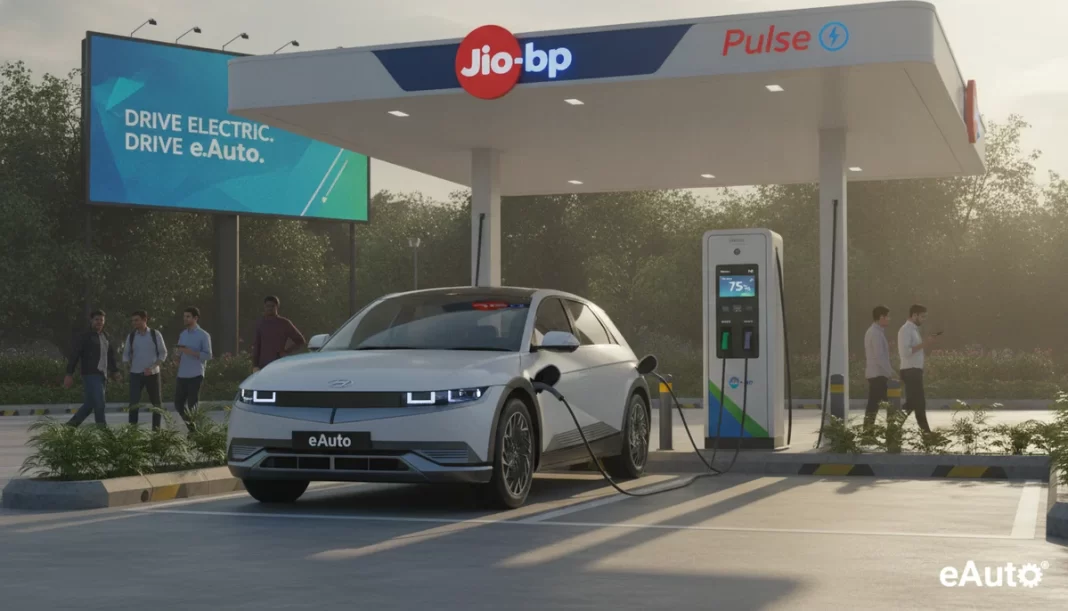
The EV charging infrastructure sector in India is moving away from merely providing hardware to offering digitally connected and interoperable charging services. A prime example of this transition is the recent partnership between Hyundai Motor India (HMIL) and Jio-bp, aiming to combine the EV charging infrastructure with its digital platform, making it easier for EV users to discover and access charging stations.

As part of the new collaboration, Hyundai Motor India will now be connecting over 7,000 Jio-bp pulse charging points across more than 300 Indian cities directly into its myHyundai application. Through this, the total number of available charging points through myHyundai app grows to more than 37,000, thereby making charging options readily available for EV customers at one place.

From Charger Hardware to Software-Driven Charging

The primary purpose of this collaboration is to offer improved accessibility and convenience for EV charging stations using a digitally integrated approach. Rather than drivers having to search across multiple charging apps, the myHyundai platform can allow drivers to be connected to more of the charging network through a single platform.

This highlights the increasing significance of interoperability within the EV ecosystem. With individual charge point operators running their own networks, apps and payment systems, incompatible digital ecosystems can fragment the public charging experience for EV drivers. Software linking networks together can reduce this fragmentation.

Hot this week

Ather Energy Launches Konarc on New EL Platform to Advance Scalable and Service-Friendly EV Technology

By launching the Ather Konarc – the first electric...

AI-Powered BMS: How Machine Learning Is Changing EV Battery Health Prediction

With the increasing growth rate of electrical vehicle adoption...

Beyond Lithium-Ion: India Tests Indigenous Iron-Air Batteries for Long-Duration Energy Storage

Driven by the need for alternatives to traditional lithium-ion...

Software May Define the Vehicle But Safety Must Govern Every Line of Code

The Tata Technologies–WITTENSTEIN partnership highlights why deterministic, safety-oriented software...

From Imported Chips to Automotive Silicon Made in India

New semiconductor projects targeting discrete devices, analog ICs and...

Topics

AI-Powered BMS: How Machine Learning Is Changing EV Battery Health Prediction

With the increasing growth rate of electrical vehicle adoption...

Software May Define the Vehicle But Safety Must Govern Every Line of Code

The Tata Technologies–WITTENSTEIN partnership highlights why deterministic, safety-oriented software...

From Imported Chips to Automotive Silicon Made in India

New semiconductor projects targeting discrete devices, analog ICs and...

ADAS for India Must Be Engineered for Indian Roads

Advanced driver-assistance systems are often described through a familiar...

India Is No Longer Just Writing Automotive Software; It’s Shaping Global Mobility

India’s relationship with the global automotive industry is changing....

Related Articles

Popular Categories