
The integration of autonomous driving and wireless power transfer is opening new possibilities for automated electric vehicle charging. MAHLE’s Park & Charge technology brings these two capabilities together, allowing an electric vehicle to locate a suitable charging space, park over an inductive charging pad and start charging automatically without requiring a physical connection.
Automated Park-and-Charge Technology Simplifies Wireless EV Charging

“Wireless charging has the potential to make electric mobility much easier in everyday life. Key to acceptance is high efficiency, maximum ease of use, the ability to automate the process, and seamless integration into existing vehicle and infrastructure concepts,” said Dr. Marco Warth, Vice President of Corporate Research and Advanced Engineering at MAHLE. “With our Park & Charge pilot, we are taking the next step by laying the foundation for an automated charging process that not only enhances convenience for users but also opens up new application opportunities for fleet operators.”
How AI and DIPS Enable Precise Wireless EV Charging
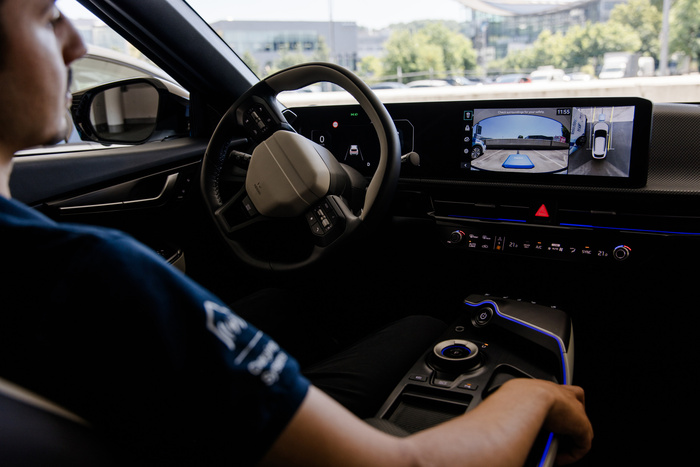
The technology uses the vehicle’s camera and AI-based algorithms to identify parking spaces equipped with wireless charging infrastructure. Once a suitable space is detected, the vehicle uses MAHLE’s Differential Inductive Positioning System (DIPS) to achieve accurate alignment with the charging pad installed beneath the parking surface. This positioning is important because the efficiency of inductive power transfer depends on the alignment between the vehicle-mounted receiver and the ground-based charging unit.
After the vehicle reaches the correct position, the wireless charging system automatically initiates power transfer through electromagnetic induction. By eliminating manual cable connections and reducing the need for driver involvement, the technology could simplify EV charging in parking facilities and support automated charging operations for commercial fleets.
Enabling Two-Way Power Transfer Through Wireless EV Charging
Another advantage of the MAHLE technology is that it already supports bidirectional charging. This means that electric vehicles will not only be able to draw energy from the power grid, but can also return stored electricity when needed, helping to stabilize future energy systems.
To advance the development and validation of this technology, MAHLE has established a dedicated wireless charging system test bench in Stuttgart, Germany. The facility is designed to support testing of current and future generations of inductive charging systems. MAHLE is also collaborating with the BMW Group to further evaluate its wireless charging technology.
Summary
MAHLE has developed an automated Park & Charge technology that combines autonomous parking with wireless EV charging. The system uses vehicle cameras and AI-based algorithms to identify parking spaces equipped with wireless charging pads. It then guides the vehicle into the correct position above the ground-mounted charging pad using its Differential Inductive Positioning System (DIPS). Once the vehicle is properly positioned, charging starts automatically through inductive power transfer, eliminating the need for charging cables or manual connections. The technology also supports bidirectional charging, allowing electric vehicles to receive electricity from the grid and send stored energy back when required. This approach can simplify EV charging while supporting future vehicle-to-grid (V2G) applications.