
Prashant Verma, Sub-Editor, ELE Times
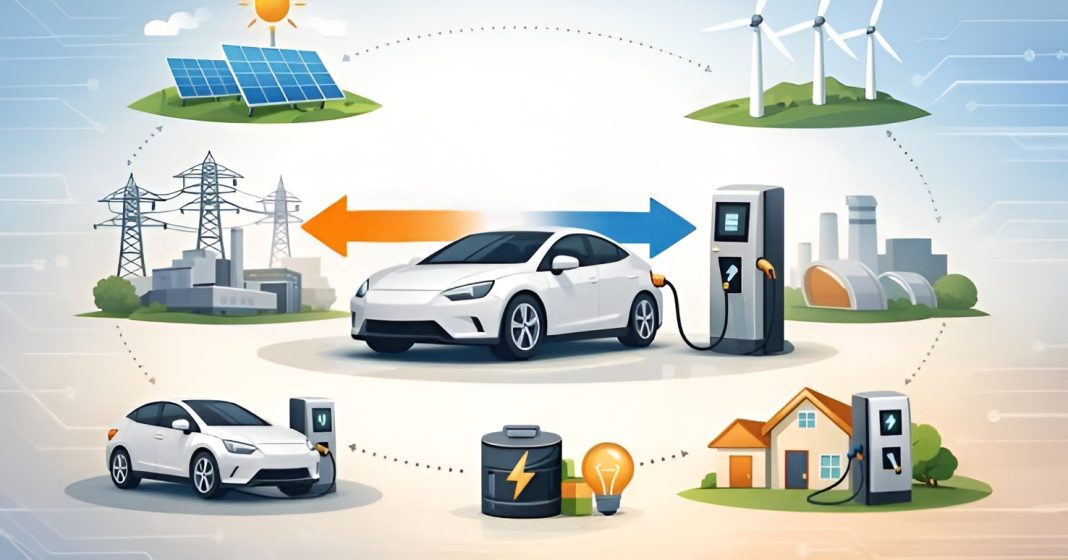
Vehicle-to-Grid (V2G) is an emerging technology enabling bidirectional power transfer by pairing the power station with the vehicle’s charging port to charge the battery in electric vehicles (EV) and supply power to the public electricity grid using bidirectional charging, power electronics, and two-way digital communication.
The primary purpose of introducing V2G technology is to balance electricity supply and demand on the power grid by using EV batteries as a source of power to be supplied to the grid. While supplying power to the public electricity grid, the user receives financial compensation and grid service rewards, depending upon local utility programs and regulations.
Understanding Vehicle-to-Grid Technology: How Does it Work?
V2G is not the only technology that transfers power back to the source to balance source availability and consumption demand. Other available technologies that transfer power back to the source include Vehicle-2-Home (V2H) and Vehicle-2-Load (V2L). The concept of energy flow during power transfer is the same: the power distributor acts as a source and the consumer acts as a consumer.
Given below is a list that explains how V2G works.
- Grid Monitoring & Signals: Grid operators monitor the balance between electricity demand and supply continuously from central control centres using real-time grid frequency, automated telemetry, and demand forecasting.
- Two-Way Power Conversion: The bidirectional power conversion placed inside the charging station converts alternating current from the grid into direct current to charge an EV and reverses its functionality to charge the grid (power station) by converting DC current from the battery into grid-synchronised alternating current.
- Smart Charging and Discharging: This is the core technology in V2G supported by bidirectional power electronics, battery controls, communication protocols, backend management software that coordinate together to supply power to an EV during surplus availability and draw power from an EV during a shortage of power supply.
- Aggregation & Control: Aggregation decides the charging and discharging capacity while transferring power in both directions from source to consumer, whereas control manages the direction of flow of energy with time and amount between the vehicle and the grid, considering electricity demand, battery conditions, and user requirements.
For a practical explanation, consider vehicle-to-home (V2H) charging technology, where an electric scooter is charged by solar energy through solar panels during daytime, when the supply is abundant and power is drawn from the scooter during the evening when the demand is excessive through appropriate grid connection and utility arrangements.
Bidirectional Power Electronics: The Technology Behind V2G
Power electronics play a very important role in transferring power between the grid and an electric vehicle. These are bidirectional converters, inverters, and switches placed on both electric vehicles and the grid, controlling the flow of electricity by regulating the frequency, phase, and voltage in real-time. Transferring power between the grid and an EV also involves converting current from AC to DC because the power grid and EV batteries operate on different types of electrical current.
Below is a list of scenarios where current conversion takes place in V2G technology along with components utilized:
- Level 1 & Level 2 Charging: Power is supplied from the grid to an EV and AC is converted into DC in this case using an EV On-Board Charger (OBC). Power is supplied directly from the charging station to EV’s onboard charger.
- DC Fast Charging (Level 3): AC is converted to DC while transferring power from the grid to EV using step-down and conversion equipment.
- Wireless Charging: Power flows from grid to an EV and conversion of electricity involve AC into high-frequency AC or AC to DC using ground pad and vehicle receiver pad.
- AC V2G: In this state, the current flows from an EV to the grid and conversion of current is from DC to AC using EV Bi-Directional On-Board Charger.
- Vehicle-to-Load (V2L): The energy stored in an EV’s battery is supplied to external components like mobile phones and power backup devices. The current is converted from DC to AC by an EV On-Board Inverter.
Silicon carbide (SiC) and gallium nitride (GaN) wide-bandgap semiconductors could improve bidirectional Vehicle-to-Grid (V2G) charging performance by reducing switching and conduction losses. Their wide-bandgap properties enable higher switching frequency, reducing the size of passive components such as capacitors, inductors, and filter components inside the bidirectional chargers, and lowering thermal losses while charging and discharging an electric vehicle.
How V2G Can Support Renewable Energy and Grid Stability
Generation from solar and wind energy is variable. When renewable generation is available and not all of it is required to meet the electricity demand at that moment, rather than disconnecting the power from the grid and increasing the amount of energy that is wasted, this excess energy is stored in the electric vehicles’ batteries. When the demand increases, or renewable generation falls below the required level, the stored power can be transferred back into the power grid.
V2G Can Support Electricity Networks Through Several Applications
- Peak Shaving: Hourly electricity demand typically peaks at certain times of the day. Utilities can utilize EV batteries connected to the grid to supply more electricity during peak demand hours, alleviating the power distribution.
- Frequency Regulation: To ensure stability, an electricity network keeps a consistent frequency level by constantly matching generation to demand. When composed of aggregated EV batteries, the grid can send a control signal to increase or decrease electricity consumption.
- Renewable Energy Integration: EV batteries can store excess solar and wind energy and discharge it back to the grid when there is little to no generation.
- Demand Response: Demand response can be used by utilities/energy aggregators to motivate EV owners to charge/discharge vehicles according to tariff rates and grid needs.
According to the International Energy Agency’s Global EV Outlook 2026, V2G and smart charging could be used as a means to lower peak demands, reduce grid congestion, and minimize required grid investment.
V2G vs V2H vs V2L: Understanding the Difference
Even though these technologies all use vehicle-to-vehicle or vehicle-to-infrastructure power transmission, they are not used for the same purpose.
- Vehicle-to-Grid (V2G): Sends electricity from an EV battery to the public electricity grid.
- Vehicle-to-Home (V2H): Provides power back to the home from stored vehicle energy, possibly acting as a backup supply or to lower energy bills.
- Vehicle-to-Building (V2B): Delivers electricity to commercial buildings, office buildings or other facilities.
- Vehicle-to-Load (V2L): Delivers energy from an EV is used to power external electrical devices, tools and equipment.
For example, the energy stored in an EV battery can run a laptop, electrical lights, or small appliances via V2L. Power can be supplied to the home through V2H in case of a power outage (if the car supports backup operation and is compatible with the home electrical system).
V2G advances that concept by enabling electric vehicles to connect directly with the public electricity grid. Using bidirectional charging infrastructure, vehicles can feed electricity back to the grid and can provide other energy management services.
Conclusion
Vehicle-to-Grid is a key step toward integrating electric mobility with the electricity ecosystem. It offers bidirectional charging and is an example of an enabler of “EVs to Grid” applications, such as balancing renewable energy penetration, peak shaving, ancillary services for grid stability, etc.
But V2G is not just about deploying a bidirectional charger; it requires aligning progress across power electronics hardware, battery management, communication protocols, cybersecurity, grid protection, and energy management software.
As the adoption of electric vehicles and the deployment of renewables increase, V2G might give a new purpose to electric cars, in addition to travel. With the right technology, commercial frameworks and regulatory incentives, parked cars could play an important role in a more flexible and resilient grid.