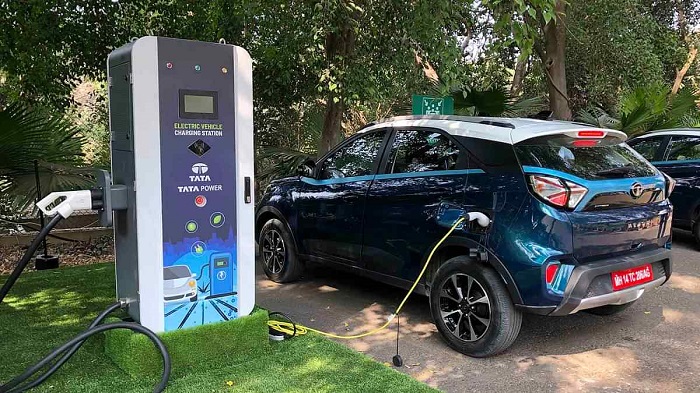

There are currently over 70,000 fuel pumps in India that form the foundation of the country’s mobility sector. In a not too distant future when vehicles would run on electricity, how many charging stations would India need? There is no clear answer to that but the company that has taken the lead in setting up charging stations across the country–Tata Power, is pressing the accelerator.
As of now, the company has set up 961 charging stations in the country–a mix of 250 slow AC charging points of 7-11 KW, 523 fast DC charging points of 15-30 KW capacity and 188 high capacity chargers of 50 KW and above. By the end of this fiscal, it hopes to more than double to 2000 charging stations. And in 5 years, it wants that number to swell five times.
“We should not look at the number of petrol pumps in the country today to try and speculate how many charging stations we would need. Unlike in the case of internal combustion engines where vehicles can only be refilled in petrol pumps, in electric vehicles, home charging will be highly prevalent. Not everybody would be dependent on public charging on a regular basis,” said Praveer Sinha, CEO and managing director, Tata Power. “We are at over 900 charging stations now and by the end of this fiscal we should cross 2000. Over the medium term in the next 5 years, we are targeting 10,000 charging stations.”
The revenue from charging is in decimal points for Tata Power and it is unlikely to change in the near future but the company is looking at the long term when an entire ecosystem will develop around charging stations. In the interim, its biggest challenge is the lack of options in four-wheeler passenger vehicles. Currently, only group firm Tata Motors has products like the Nexon EV and the recently launched Tigor EV in the relatively affordable price bracket. The others like the Hyundai Kona, MG ZS EV, Mercedes EQC or Audi etron all cost over Rs 20 lakh.
“If you ask me, I can see that the customer is ready. Or at the very least he is somewhat willing to look at an EV now. What constrains us is the lack of options,” Sinha said. “It restricts the business viability. Currently, the utilization rate is only around 1-3 percent. We need at least 20 percent for it to be viable. It is not a chicken and egg problem anymore. There is traction in two and three-wheelers. Charging stations are coming up. What is missing is electric four-wheelers. We need more companies to join the fray and expand the market.”