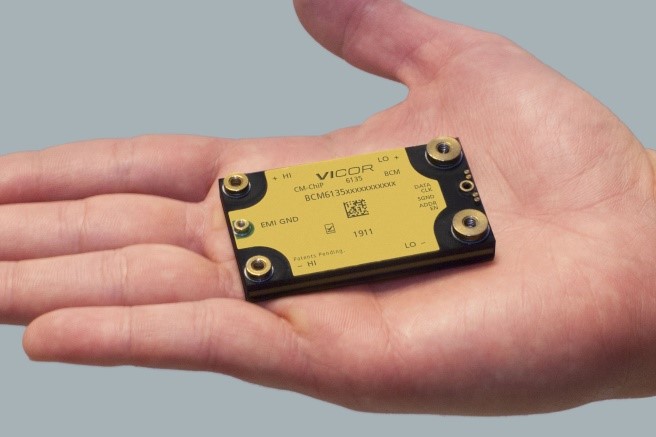

Reduced size and weight of the power delivery network are essential factors for the next generation of xEV platforms. Vicor products are the most power-dense products available for EVs. For example, 2.5kW of power from the Vicor BCM6135 can be held in the palm of your hand.
Vicor will unveil three new approaches for powering xEVs at the premiere global automotive engineering event, World Congress Experience (WCX) in Detroit on April 5-7, 2022. Proven Vicor solutions using high-density power modules and new power delivery architectures, deliver up to a 50% reduction in power losses.
Addressing three top electrification topics, Vicor’s presentations offer innovative modular solutions that save simplify power system design and increase scalability and flexibility.
Vicor high-density solutions:
- Eliminating the 12V Lead Acid Battery: An inventive power architecture that replaces the 12V battery with a “virtual battery,” saving space and weight, and replacing legacy technology; Presenter, Patrick Kowalyk, Automotive Principal Field Applications Engineer (April 5, @10:30am, Room 140B, session PFL710)
- The Impact of Miniaturized Power Modules on Electrification: Power-dense modules combined with innovative power architectures deliver unprecedented design flexibility, scalability and space savings for xEV development; Presenter, Greg Green, Director, Automotive Customer Programs (April 6, @10:30am, Room 140C, session PFL740)
- DC Charging Station Compatibility: Higher-voltage primary batteries (800V) create a 400V charging station incompatibility that can be solved with onboard charging using compact, efficient and bidirectional power modules; Presenter, Haris Muhedinovic, Automotive Senior Field Applications Engineer (April 7, @9:30am, Room 260, session AE600)
Vicor’s high-performance, high-density power modules uniquely solve automotive electrification challenges
As the automotive industry aggressively moves toward full electric vehicles, power system design engineers are grappling with how to design significantly higher power delivery networks. EV’s require up to 20x more electrical power than a traditional internal combustion engine vehicle which requires proportional size and weight increase for the power electronics. Vicor power modules help engineers create high density power delivery networks for EV, PHEV, HEV and BEVs that are lightweight, efficient and offer an easily scalable platform.