
onsemi Unveils Advanced Semiconductor Packaging to Improve EV Inverter Efficiency

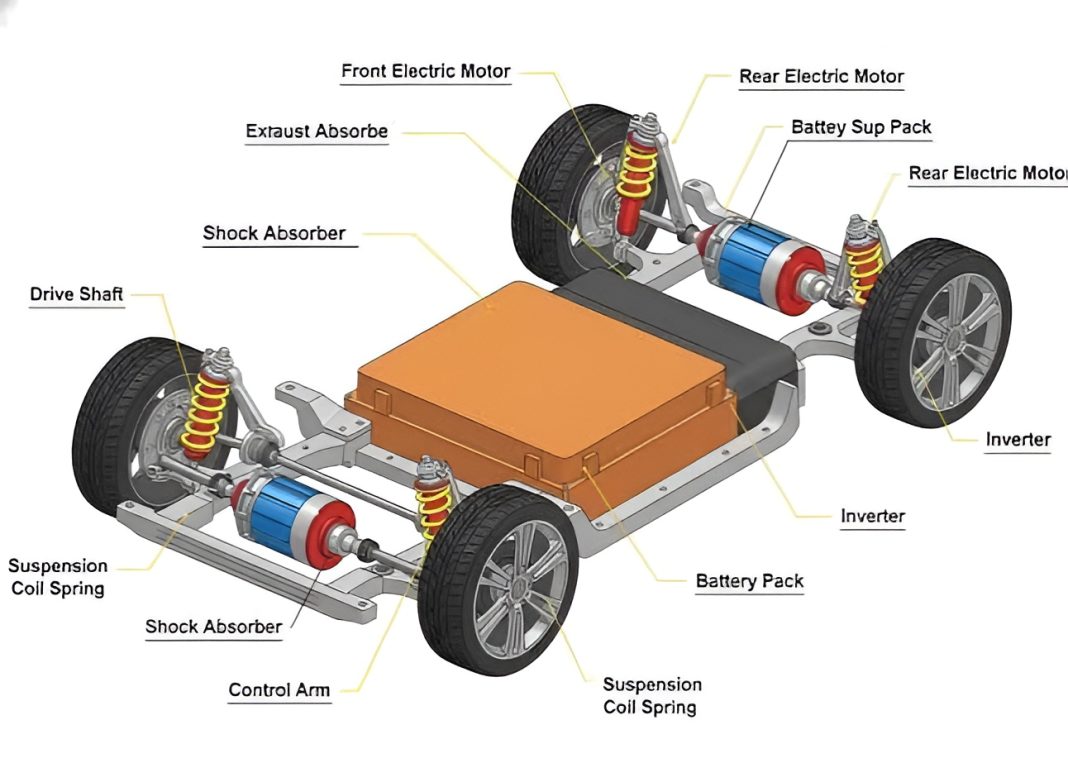
​Semiconductor manufacturer onsemi, specialised in silicon carbide (SiC) power solutions, power management, and CMOS image sensors has introduced its Embedded Power Platform—a wafer-level power architecture that integrates multiple dies (silicon, SiC, and GaN) directly into a single system. This new semiconductor packaging architecture enables higher power density, lower electrical losses and easier power-system integration. This platform has the potential to develop traction inverters and power systems that are smaller and more efficient for EVs.

​onsemi announced the Embedded Power Platform on September 16, 2026, at its headquarters in Scottsdale, Arizona, USA. The architecture delivers up to 3-5 times higher power density compared to current traction inverters. It supports the integration of silicon, silicon carbide, and gallium nitride (GaN) technologies, along with field-effect transistors, drivers, and controllers.

Advance Packaging Reduces EV Power Losses

Traction Inverter design developed by onsemi replaces high-in​ductive wire bonds with precision wafer-level redistribution layers (RDLs). This method reduces inductance and performs higher switching frequency operations. It reduces heat loss and increases EV traction inverter efficiency by addressing both thermal and performance challenges simultaneously.

Subaru Corporation, a Japanese multinational automotive manufacturing company has shown interest in implementing this embedded power platform developed by onsemi in its future electrified vehicles. This technology engagements between industries allows them to explore methods that can enhance energy efficiency, reduce development complexity, and facilitate next-generation vehicle architecture.

Hot this week

Enabling The Transportation Industry to Drive Growth on The Hybrid Cloud

Anwesh Koley, Executive Editor, ELE Times Players in the mobility...

Can Vehicle-to-Grid Technology Turn Electric Vehicles into Mobile Power Stations?

Prashant Verma, Sub-Editor, ELE Times Vehicle-to-Grid (V2G) is an emerging...

Top 10 Sodium-Ion Battery Companies for Electric Mobility

Sodium-ion batteries are rechargeable batteries made of a cathode,...

L&T Technology Services Introduces SDVault.ai, an AI-Powered Toolchain for Software-Defined Vehicles

L&T Technology Services announced the launch of SDVault.ai on...

EV Efficiency Explained: Wh/km, Regenerative Braking, Aerodynamics and Thermal Losses

Electric vehicles (EVs) are mobility products powered partially or...

Topics

Enabling The Transportation Industry to Drive Growth on The Hybrid Cloud

Anwesh Koley, Executive Editor, ELE Times Players in the mobility...

Can Vehicle-to-Grid Technology Turn Electric Vehicles into Mobile Power Stations?

Prashant Verma, Sub-Editor, ELE Times Vehicle-to-Grid (V2G) is an emerging...

Top 10 Sodium-Ion Battery Companies for Electric Mobility

Sodium-ion batteries are rechargeable batteries made of a cathode,...

EV Efficiency Explained: Wh/km, Regenerative Braking, Aerodynamics and Thermal Losses

Electric vehicles (EVs) are mobility products powered partially or...

CATL Explores Lithium-Air Battery Technology to Advance Next-Generation Electric Vehicles

​CATL, the world’s largest manufacturer of energy storage batteries,...

KAIST Develops Semiconductor-Based Interface Technology to Extend Anode-Free EV Battery Life

Researchers from the Korea Advanced Institute of Science and...

GÖPEL Electronic Joins Automotive SerDes Alliance to Support ASA-ML Automotive Networking

High-speed communication technologies are becoming increasingly important in modern...

Related Articles

Popular Categories