
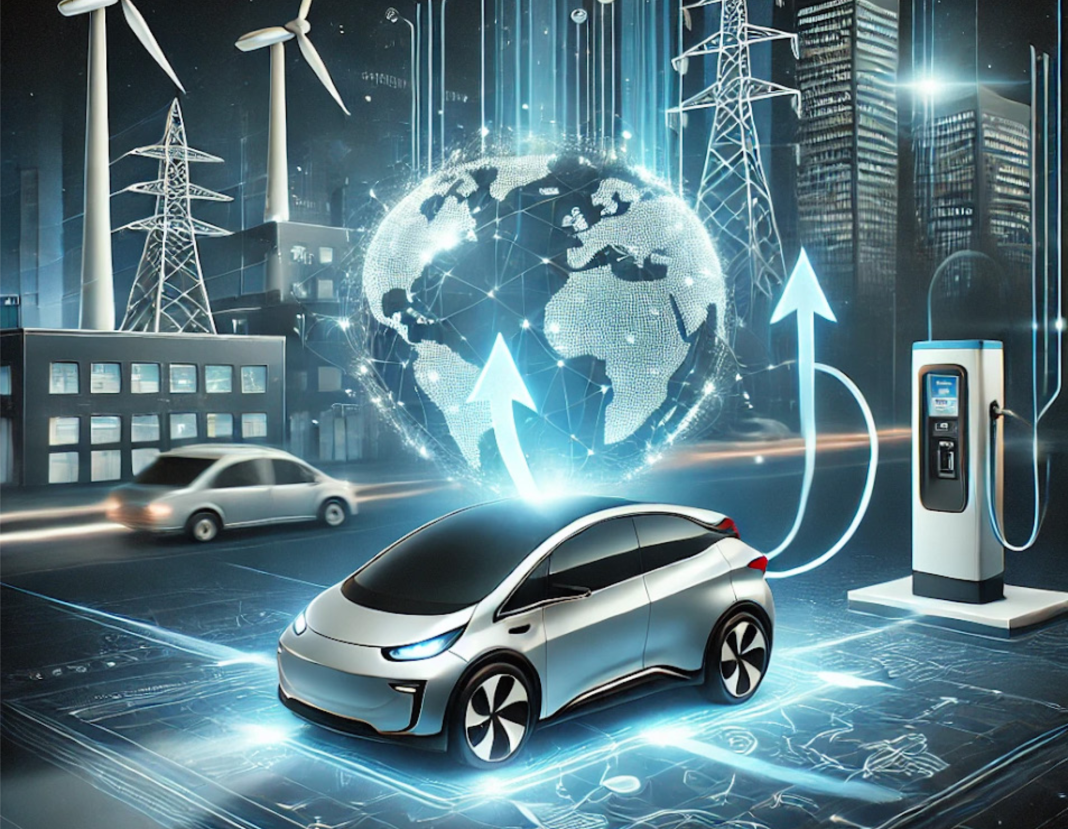

Much of the research around emerging technologies in Electric vehicles is looking within the EV system and lack a comprehensive review of EV integration and its impact on Power system planning and operation, across transmission and distribution levels.
Shift Toward Bidirectional Energy Flows
Vehicle to Grid (V2G) charging is a phenomenal step taken in direction of placing EVs on the energy landscape where they can contribute to grid stability. V2G integration provides a paradigm shift from an era of unidirectional energy flow and introduces bidirectional energy transfer between EVs and energy grid. EVs essentially act as renewable energy storage units facilitating load balancing, peak shaving and frequency regulation within the grid.
Core Components of V2G Systems
- EV as Portable Energy Storage: The V2G system primarily consist of EV as a potable energy storage system fitted with a battery management system (BMS).
- EVSE, Chargers and Communication Interfacee: The Electrical vehicle supply equipment (EVSE) is connected to the EV, including a bidirectional charger and a communication interface that allows data flow between EV, grid and the user.
- Supporting Infrastructure: It also integrates a transformer to manage voltage levels, a smart meter for precise monitoring and an aggregator platform for coordination of combined energy sources from many EVs.
Variants of Bidirectional Charging
In addition to V2G, bidirectional energy transfer covers V2H (vehicle-to-home) and V2L (vehicle-to-load) charging.
Global Deployment Landscape
Adoption Examples: Virta Global, is a European country headquartered at Helsinki, Finland that is leading in providing V2G solutions. It has installed seven V2G chargers at its premises in Finland. Virta has installed 20 chargers at a Nissan manufacturing plant in the UK.
Economic Considerations
Battery Cycling and Infrastructure Costs: There are, however, cost considerations to be considered with V2G charging. The batteries in a V2G setup are subject to wear and tear due to frequent charging and discharging cycles. Advance chargers and communication systems add to the cost, even though a part of it is offset by revenue opportunities gained from selling stored energy.
Impact on Power Networks
- Grid Benefits and Load Management: The electrical network is largely benefited by V2G charging during load shifting, load building, power conservation, peak clipping, valley filling and flexible loads. As increasingly EVs get integrated into the system, power imbalances on the load side are bound to occur. The ancillary services provided by the V2G setup help in alleviating certain congestions on the network.
Role of Aggregators and Control Models
Aggregation for Frequency Control: Aggregation of numerous EVs into grid through V2G setup for primary frequency control is a critical to larger EV integration into the transportation system. Aggregators assist in providing services to individual EVs and serve the purpose of a bigger and more appropriate load for utility.
Models Used in Research
Studies are ongoing on several aggregated models for large-scale EV integration. Some researchers use an independent distributed Vehicle to grid regulation arrangement while others use master slaves grid regulation technique for microgrid (MG) in islanding mode.
Modified Droop Controller Approach
However, modified droop controller method is considered better than others where the reference signal is controlled and monitored uninterruptedly by a droop controller possessing feedback mechanism. Such controller is known as Modified droop controller.
Technical Capabilities of V2G Systems
- Active and Reactive Power Support: In V2G system, the vehicle can provide active power regulation, current harmonic filtering, reactive power support and tracing of adjustable renewable energy sources.
- Ancillary Services: With the help of these, ancillary services such as frequency and voltage control can be facilitated.
Microgrid-Level Power Balancing
Optimized Charging Schedules: A better balance of power in a microgrid can be achieved by Vehicle to grid systems. With the help of intelligent charging schedules, the vehicle can discharge during peak hours, charge during off-peak hours, thereby improving the load curve.
Voltage and Frequency Regulation
Up and Down Regulation
Regulation of voltage and primary frequency are crucial for energy markets. When the voltage supply from the grid is high, the EV battery is in charging state known as down regulation. On the contrary, when supply from the grid is low, EV battery is in discharging state also known as up regulation. This may affect the frequency. The primary purpose of frequency control is to maintain equilibrium between generation and demand within specific time duration. Regulation services can be provided within V2G systems to reduce pressure on the power grid.
Harmonic Filtration and Power Quality
Need for Harmonic Control: Maintaining the quality of power supplied back to the grid through Harmonic filtration is essential for any emerging V2G technology.
Advances in Digital IIR Filters: Recently, real-time digital infinite impulse response (IIR) filters are developed for the same. IIR filters generate reference signals at the power calculation stage. Digital filters offer various advantages over passive and active filters in inverter output signals of V2G applications like real-time processing, adaptability, improved performance with better noise reduction, increased control and lower costs.
V2G Applications in Fuel-Cell EVs
IIR Filters in FCEVs: Digital IIR filters are mostly implemented in Fuel Cell Electric vehicles (FCEVs) because they require less memory and have less computational complexity.
Global Research Initiatives
The European Union’s Hydrogen Mobility Europe 2 (H2ME2) project is researching and developing V2G technology for FCEVs to demonstrate the technology in a real-world setting. Other companies, such as Toyota and Hyundai, have also announced plans to develop V2G technology for their FCEVs. Moreover, companies like Texas instruments are researching on application of digital IIR filters.
Conclusion: EVs as Grid Assets
Electric vehicles can act both as a load and a potential power source which can be integrated into the power system when required. Adequate studies on the stresses that a power distribution system can experience due to large scale EV adoption are imperative and equally imperative is to come up with alternatives like V2G technology that can overcome some of these challenges.


 charging is a phenomenal step taken in direction of placing EVs on the energy landscape where they can contribute to grid stability. V2G integration provides a paradigm shift from an era of unidirectional energy flow and introduces bidirectional energy transfer between EVs and energy grid.)